Shijiazhuang Zhengdrilling Machinery Equipment Co., Ltd.
Service Email: bruce@well-drillrigs.com
Bruce:+86-18603299555
 EN
 ES
 FR
 RU

Not every groundwater project requires the same drilling equipment. A contractor constructing a standard agricultural well may have very different requirements from a company developing a deep industrial water supply well or a geothermal borehole.
When a project involves greater drilling depth, larger borehole diameters and demanding lifting requirements, the drilling rig needs to provide a suitable combination of power, drilling capacity and supporting equipment.
The ZD1600 deep water well drilling rig from ZDrill Machinery is designed for deep drilling applications, including ultra-deep drinking water wells, geothermal wells and large industrial water supply well construction.
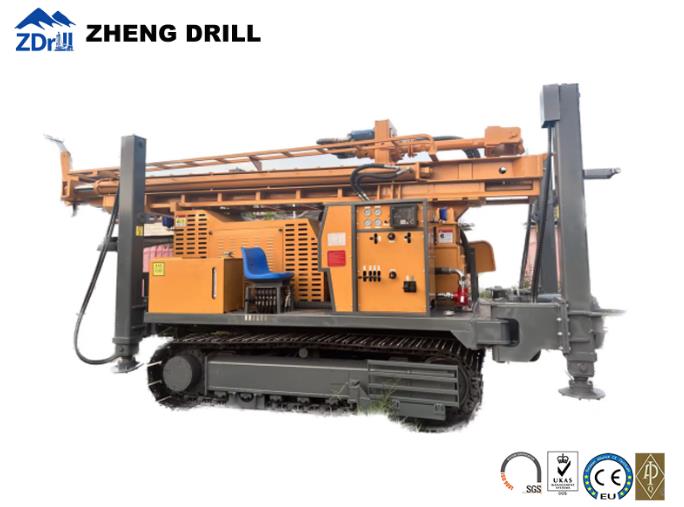
With a listed maximum drilling depth of 1,600 meters and a drilling diameter range of 127–700 mm, the ZD1600 provides a configuration for projects where both depth and borehole dimensions need careful consideration.
This article examines its technical specifications, drilling capabilities and potential applications to help drilling contractors and equipment buyers evaluate whether this model matches their project requirements.
The ZD1600 is a crawler-mounted, full-hydraulic drilling rig developed for deep drilling work.
Its specifications cover several important areas: drilling depth, borehole diameter, lifting capacity, rotary torque, air supply and drilling speed.
The following table summarizes the manufacturer's published parameters.
| Technical Parameter | ZD1600 Specification |
|---|---|
| Maximum drilling depth | 1,600 m |
| Drilling diameter | 127–700 mm |
| Working air pressure | 1.65–8 MPa |
| Air consumption | 16–120 m³/min |
| Drill pipe length | 3–6 m |
| Drill pipe diameter | 114 / 127 / 140 mm |
| Thrust force | 20 T |
| Lifting force | 60 T |
| Fast hoisting speed | 29 m/min |
| Fast feeding speed | 50 m/min |
| Engine | 264 kW Cummins engine |
| Maximum rotary torque | 12,000–24,000 N·m |
| Rotary speed | 75–160 r/min |
| Main winch lifting capacity | 4 T |
| Auxiliary winch lifting capacity | 1.5 T |
| Hydraulic outrigger stroke | 1.7 m |
| Listed drilling efficiency | 10–38 m/h |
| Travel speed | 3.5 km/h |
| Climbing capacity | 35° |
| Machine weight | 20 T |
| Overall dimensions | 6.6 × 2.25 × 3 m |
Optional equipment includes a mud pump, welding generator, pipe reamer and air compressor.
These are published product specifications, not guaranteed results for every geological formation. Actual drilling performance depends on the selected drilling method, borehole diameter, formation, drilling tools and operating conditions.
Drilling depth is often the first specification buyers ask about. However, borehole diameter can be equally important when planning a deep water well.
The ZD1600 has a published drilling diameter range of 127–700 mm. This provides buyers with a range of borehole sizes to evaluate according to the well design.
Some deep groundwater projects use relatively small borehole diameters. In these applications, the contractor needs to consider the target aquifer, casing arrangement, pump installation requirements and drilling tools.
The selected diameter should provide enough space for the planned well construction components without creating unnecessary drilling requirements.
Large-diameter drilling may be required for certain industrial water supply and water infrastructure projects.
A larger borehole can involve different requirements for:
Drilling torque and lifting capacity
Drill bit and reamer selection
Casing dimensions
Cuttings removal
Drilling fluid or compressed air supply
Borehole stability
The maximum listed diameter of 700 mm makes the ZD1600 worth evaluating for projects requiring larger boreholes. However, the maximum diameter and maximum depth should not automatically be assumed to be achievable together under every configuration.
Buyers should provide the planned depth and diameter combination for technical confirmation.
As a borehole becomes deeper, the drilling system needs to handle a longer drill string and the corresponding operational loads.
The ZD1600 is equipped with a full-hydraulic drive system and a listed lifting force of 60 tons.
Its maximum rotary torque is specified at 12,000–24,000 N·m, while the thrust force is listed as 20 tons.
These parameters are important when evaluating the machine for deep drilling projects.
Lifting capacity is relevant when raising the drill string, handling drilling tools and carrying out operations during borehole construction.
The listed 60T lifting force gives buyers a key reference when comparing deep drilling equipment.
The actual load and operating limits must still be checked against the manufacturer's technical guidance.
Rotary torque affects the rig's ability to drive the drilling assembly.
The appropriate torque requirement depends on the selected drilling method, drill string, bit design and geological conditions.
A project involving different formations may require adjustments to the drilling parameters rather than simply operating at maximum torque.
The full-hydraulic system is designed to control the major drilling movements.
For contractors, this makes it important to understand the available operating adjustments and how they correspond to the selected drilling method.
The final configuration should be confirmed with the manufacturer before ordering.
Different formations and well designs may require different drilling methods. The ZD1600 product information lists three drilling approaches:
Top-drive hydraulic rotary drilling and thrusting
DTH hammer drilling
Mud drilling
The appropriate method should be selected according to the formation, borehole design and project requirements.
Hydraulic rotary drilling uses the rig's rotary system to drive the drill string and drilling tool.
This method can be considered for projects where the drilling design and formation are suitable for rotary drilling.
Before selecting this method, buyers should confirm the required torque, drill pipe specifications, bit type and circulation arrangement.
Down-the-hole hammer drilling uses a pneumatic hammer positioned near the bottom of the borehole.
Compressed air supplies the energy required to operate the hammer and helps remove drilling cuttings.
DTH drilling is commonly considered for suitable hard-rock formations.
For a DTH configuration, the compressor, hammer, bit and drill pipe need to be matched as a complete system.
Mud drilling uses drilling fluid to support the drilling process.
Depending on the formation and borehole design, drilling fluid can help transport cuttings and support borehole stability.
A suitable mud pump and circulation system should be selected according to the required flow rate, pressure and drilling conditions.
The ZD1600 lists a mud pump as optional equipment. Buyers should confirm the required pump model and system configuration for their project.
Industrial facilities may require a reliable groundwater source for production, processing, cooling or other operational purposes.
Compared with a small domestic well, an industrial water supply project may involve different requirements for well depth, borehole diameter, water demand and well construction.
The ZD1600 deep water well drilling rig is listed for large industrial water supply well construction.
When evaluating this model for an industrial project, buyers should consider several factors.
The required water yield should be established through the project's hydrogeological assessment.
A larger drilling rig does not automatically guarantee a higher water yield. The available groundwater resource and well design are also important.
The planned borehole diameter should be determined according to the well design and casing requirements.
The drilling rig, drill pipes, bits and casing equipment must be compatible with the selected dimensions.
Industrial water wells may pass through several geological layers.
The project team should provide information about soil, sand, gravel, weathered rock and hard-rock formations where applicable.
This information helps determine the appropriate drilling method and supporting equipment.
The drilling contractor should also evaluate transportation, equipment installation, drilling procedures and supporting equipment availability.
These details are important when planning a large-scale groundwater project.
Deep drinking water wells may be required where the target groundwater-bearing formation is located below shallower geological layers.
The actual depth depends on local hydrogeological conditions. A 1,600-meter-capacity drilling rig should therefore be selected only after the project team has reviewed the expected aquifer depth and well design.
The ZD1600 provides a listed maximum drilling depth of 1,600 meters and can be evaluated for deep groundwater development projects.
Before choosing the machine, contractors should clarify:
Expected aquifer depth
Planned total borehole depth
Required borehole diameter
Geological structure
Water quality and well completion requirements
Drilling method
Casing and pump installation plan
These details are more useful for equipment selection than relying on the project description alone.
A drilling rig is responsible for constructing the borehole. The final water supply performance also depends on the groundwater resource, well development and pumping system.
Geothermal projects involve drilling into underground formations to access thermal resources.
Depending on the project, the drilling plan may require greater depth, specific borehole dimensions and suitable drilling tools.
ZDrill lists geothermal wells among the applications of the ZD1600.
For a geothermal project, equipment selection should consider:
The target depth should be established according to the geothermal resource assessment and project design.
The geological profile and expected downhole conditions should be reviewed before confirming the drilling configuration.
The selected drilling method should be compatible with the formation and borehole design.
Drill pipes, bits, air compressors or mud pumps should be matched to the drilling system.
A geothermal project may involve requirements beyond those of a conventional water well. Buyers should provide the project specifications to the manufacturer instead of assuming that a standard water well configuration is automatically suitable.
The ZD1600 uses a crawler-mounted chassis.
For large drilling equipment, site accessibility and ground conditions are important parts of project planning.
A crawler platform can be considered for drilling sites where tracked mobility is useful, such as:
Uneven working surfaces
Unpaved construction areas
Agricultural and rural locations
Remote drilling sites
Sites with changing ground conditions
The ZD1600 has a listed travel speed of 3.5 km/h and a climbing capacity of 35°.
These specifications provide a reference for preliminary equipment evaluation. Actual mobility depends on ground conditions, machine loading, slope, safety requirements and site preparation.
Because the ZD1600 is a 20-ton machine, transportation planning is also necessary.
Before shipment, buyers should confirm the machine dimensions, transport weight, loading arrangements and destination-country requirements.
ZDrill offers different drilling rig configurations for deep groundwater projects. The ZD1600 and ZD-2000 are two models buyers may compare when planning deeper drilling work.
Their published specifications show differences in maximum depth, borehole diameter, lifting capacity and drilling configuration.
| Comparison | ZD1600 | ZD-2000 |
|---|---|---|
| Maximum drilling depth | 1,600 m | 2,000 m |
| Listed drilling diameter | 127–700 mm | Up to 500 mm |
| Lifting force | 60 T | 100 T |
| Engine | Cummins 264 kW | Cummins 410 kW |
| Maximum rotary torque | 12,000–24,000 N·m | 38,000 N·m |
| Chassis | Crawler | Crawler |
| Listed drilling methods | Hydraulic rotary, DTH, mud drilling | Reverse circulation |
The ZD1600 may be worth evaluating when the planned depth is within its listed capacity and the project requires a larger drilling diameter range.
The ZD-2000 may be considered when the project requires greater listed depth and lifting capacity.
However, the comparison is not a simple ranking of one machine over another. The drilling method, diameter-depth combination, geological conditions and equipment configuration must all be considered.
For more details, buyers can also review the ZD-2000 Crawler Water Well Drilling Rig.
A deep water well drilling rig is only one part of the complete drilling system.
The supporting equipment should be selected according to the drilling method and project requirements.
For pneumatic drilling and DTH applications, the compressor must provide suitable working pressure and air volume.
The ZD1600 lists a working air pressure of 1.65–8 MPa and air consumption of 16–120 m³/min.
The compressor configuration should be matched to the actual hammer and drilling requirements.
For mud drilling, the pump needs to provide the required flow and pressure for the selected borehole design.
ZDrill lists a mud pump as optional equipment for the ZD1600.
The published ZD1600 specifications include drill pipe diameters of 114 mm, 127 mm and 140 mm, with lengths of 3–6 meters.
The final drill pipe configuration should be confirmed according to the drilling method and connection requirements.
The drill bit should match the formation and selected drilling method.
For DTH drilling, the hammer and bit must also be compatible with the compressor and drill string.
The product page lists a pipe reamer and welding generator among the optional equipment.
Buyers should identify which accessories are required for their planned operations before requesting a complete quotation.
For a deep drilling project, a useful quotation should be based on actual technical requirements rather than a general request for a 1,600-meter drilling rig.
When contacting a deep water well drilling rig manufacturer, prepare the following information:
| Required Information | Example |
|---|---|
| Project application | Industrial water supply, drinking water or geothermal |
| Target drilling depth | 1,200 m, 1,400 m or 1,600 m |
| Borehole diameter | Required diameter or diameter range |
| Geological conditions | Soil, gravel, weathered rock or hard rock |
| Drilling method | DTH, mud drilling or hydraulic rotary |
| Site environment | Remote area, construction site or uneven terrain |
| Supporting equipment | Air compressor, mud pump, drill pipes and tools |
| Destination country | Country and delivery location |
| Quantity | Required number of drilling rigs |
If the drilling method has not yet been decided, provide the geological report and preliminary borehole design.
The manufacturer can then review the information and confirm which configuration is available for the project.
ZDrill Machinery is operated by Shijiazhuang Zhengdrilling Machinery Equipment Co., Ltd., based in Shijiazhuang, Hebei, China.
The company supplies drilling equipment for water well construction, geological exploration, geothermal projects and other drilling applications.
Its product portfolio includes:
Crawler water well drilling rigs
Truck-mounted water well drilling rigs
Trailer-mounted drilling rigs
Deep water well drilling rigs
Reverse circulation drilling rigs
Core drilling rigs
DTH drilling equipment
Air compressors and mud pumps
Drill pipes and drilling tools
For deep well development projects, ZDrill states that it can customize crawler water well drilling rigs according to drilling depth and construction requirements.
The ZD1600 deep water well drilling rig is one option for buyers who need a machine with a listed maximum drilling depth of 1,600 meters and a drilling diameter range of 127–700 mm.
Explore the ZD1600 Deep Water Well Drilling Rig product page for the published specifications.
You can also visit the ZDrill product catalog to review other drilling rigs and supporting equipment.
The ZD1600 has a listed maximum drilling depth of 1,600 meters. Actual drilling depth depends on the formation, borehole diameter, drilling method and equipment configuration.
The published drilling diameter range is 127–700 mm. Buyers should confirm the applicable diameter and depth combination with the manufacturer.
The listed lifting force is 60 tons. The machine also has a 20-ton thrust force.
The published specification lists a 264 kW Cummins engine.
The product page lists top-drive hydraulic rotary drilling and thrusting, DTH hammer drilling and mud drilling.
The manufacturer lists large industrial water supply well construction among its applications. The final suitability depends on the required depth, borehole diameter, geology and well design.
The manufacturer identifies bedrock and hard rock among the applicable conditions and lists DTH hammer drilling as one of the available methods. The hammer, bit and air compressor must be matched to the actual formation and operating requirements.
The product page lists an air compressor as optional equipment. Buyers should confirm whether it is included in the quotation and whether its pressure and air volume match the selected drilling method.
The ZD1600 has a listed maximum depth of 1,600 meters and a 127–700 mm drilling diameter range. The ZD-2000 has a listed maximum depth of 2,000 meters and a maximum drilling diameter of 500 mm. Their lifting capacities and drilling configurations also differ.
The ZD1600 Deep Water Well Drilling Rig is designed for deep groundwater development, large industrial water supply wells and geothermal drilling projects.
Its published specifications include a maximum drilling depth of 1,600 meters, a drilling diameter range of 127–700 mm, a 60-ton lifting force and a 264 kW Cummins engine. The machine also supports several listed drilling methods, including hydraulic rotary drilling, DTH hammer drilling and mud drilling.
For drilling contractors and international equipment buyers, the key is to match the machine with the actual borehole design, formation, drilling method and supporting equipment.
If your project requires a deep water well drilling rig for industrial water supply, drinking water development or geothermal applications, contact ZDrill Machinery with your drilling depth, borehole diameter and geological information to discuss a suitable equipment configuration.
Processing Demand Survey
x


