Shijiazhuang Zhengdrilling Machinery Equipment Co., Ltd.
Service Email: bruce@well-drillrigs.com
Bruce:+86-18603299555
 EN
 ES
 FR
 RU

When a water well project requires drilling to several hundred meters, choosing the right drilling equipment becomes an important part of project planning. Drilling depth, geological conditions, borehole diameter, transportation requirements, and operating methods all influence the final equipment selection.
A 500m crawler water well drilling rig is designed for projects that require a drilling depth of up to 500 meters in its standard configuration. With a crawler chassis and full-hydraulic operating system, this type of equipment can be considered for rural water supply, agricultural irrigation, geothermal projects, and industrial water well construction.
The ZD500 Water Well Drilling Rig from ZDrill Machinery is a crawler-mounted, full-hydraulic drilling machine designed for different drilling conditions. This guide introduces its main features, technical specifications, applications, and the factors buyers should consider before purchasing.
A 500 meter water well drilling rig is a drilling machine with a rated maximum drilling depth of approximately 500 meters under its specified configuration and working conditions.
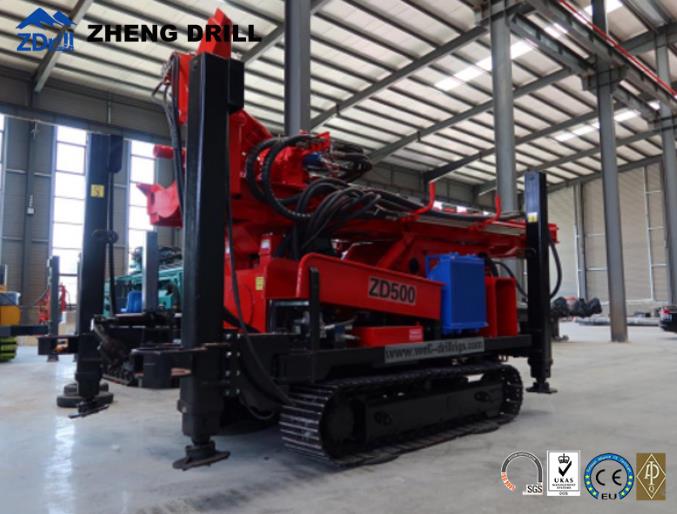
The crawler-mounted design allows the machine to move around suitable construction sites without requiring a separate truck chassis for every short-distance relocation.
The ZD500 adopts a full-hydraulic structure. Hydraulic power controls key drilling movements, including rotation, feeding, and lifting. Its drilling system can work with DTH percussion drilling or mud drilling, depending on the selected configuration and geological conditions.
This type of machine may be suitable for contractors who need a drilling rig for medium-depth water wells and related engineering projects.
It is important to distinguish rated maximum depth from guaranteed drilling performance. Actual drilling depth and speed depend on the formation, borehole diameter, drilling method, tools, and operating conditions.
The ZD500 uses a full-hydraulic driving structure to control the main drilling operations.
The hydraulic system allows operators to adjust drilling movements according to different formation requirements. Parameters such as rotation speed, torque, thrust pressure, and lifting speed can be adjusted within the machine's operating range.
For drilling contractors, this flexibility is useful when working through changing geological layers.
A full-hydraulic system also makes it important to consider routine maintenance. Buyers should understand the hydraulic components, recommended maintenance intervals, and availability of replacement parts before purchasing.
The crawler chassis is designed for movement around drilling sites where ordinary road vehicles may not be convenient.
Compared with a truck-mounted configuration, a crawler-mounted water well drilling machine can move independently around suitable off-road working areas.
Typical considerations include:
Ground conditions at the construction site
Available working space
Access routes for equipment transportation
Ground bearing capacity
Slope and site preparation requirements
The crawler chassis does not eliminate the need for transportation planning. Buyers should confirm machine dimensions, total weight, loading arrangements, and transportation requirements before delivery.
The ZD500 is listed with a standard maximum drilling depth of 500 meters.
This capacity makes it a potential choice for projects that require deeper boreholes than those typically handled by smaller shallow-well drilling machines.
The actual depth that can be achieved depends on several factors:
Geological formation and rock hardness
Required borehole diameter
Drill pipe length and diameter
Drilling method
Air compressor or mud pump configuration
Drilling tools and operating conditions
For projects requiring a different depth or borehole diameter, buyers should discuss the complete technical requirements with the manufacturer rather than selecting equipment based on the depth figure alone.
The ZD500 product information describes two drilling approaches: down-the-hole (DTH) impact drilling and mud drilling.
These methods serve different geological and operational requirements.
DTH drilling uses a pneumatic hammer positioned near the drill bit to break rock. It is commonly considered for hard-rock formations where compressed air can be supplied at the required pressure and flow rate.
Mud drilling uses circulating drilling fluid to help carry cuttings out of the borehole and support borehole stability. It may be considered for loose or unstable formations, depending on the drilling design.
The appropriate method should be selected according to geological information, borehole design, water conditions, and available auxiliary equipment.
The published ZD500 specifications include a lifting force of 28 tons and a maximum rotary torque range of 8,500–11,000 N·m.
These parameters are relevant when evaluating the machine's ability to handle drill pipes and perform drilling operations.
Buyers should consider lifting capacity together with drill pipe specifications, borehole depth, drilling tools, and the overall drilling system.
A higher parameter value does not automatically mean that a machine is suitable for every project. The complete configuration needs to match the intended application.
The following table summarizes the technical information published for the ZD500 model.
| Specification | Published Parameter |
|---|---|
| Model | ZD500 |
| Rig Type | Crawler Full-Hydraulic Water Well Drilling Rig |
| Maximum Drilling Depth | 500 m |
| Drilling Diameter | 105–350 mm |
| Working Air Pressure | 1.05–4.5 MPa |
| Air Consumption | 16–60 m³/min |
| Drill Pipe Length | 3 m / 4.5 m / 6 m |
| Drill Pipe Diameter | 89 / 102 / 114 mm |
| Axial Pressure | 12 T |
| Lifting Force | 28 T |
| Maximum Rotary Torque | 8,500–11,000 N·m |
| Rotation Speed | 75–150 rpm |
| Walking Speed | 3.5 km/h |
| Climbing Ability | 21° |
| Engine | Yuchai 153 kW, 6 cylinders |
| Machine Weight | Approx. 11.5 T |
| Overall Dimensions | Approx. 5.8 × 2.25 × 2.55 m |
| Drilling Methods | DTH Impact Drilling / Mud Drilling |
Specifications are based on the published ZD500 product information. The final configuration, operating parameters, and included accessories should be confirmed with ZDrill before ordering.
A medium-depth drilling rig can serve different water resource development and engineering requirements. The most suitable application depends on the planned borehole depth, geological conditions, and equipment configuration.
Rural communities may rely on groundwater wells to provide water for households and local facilities.
For projects requiring medium-depth boreholes, a 500m water well drilling rig can be evaluated according to the local groundwater survey and drilling plan.
Before construction, project planners should confirm the expected aquifer depth, water demand, borehole diameter, and local regulations.
Drilling to a specified depth does not guarantee that a suitable groundwater source will be found. Geological investigation and subsequent water quality testing remain important parts of the project.
Agricultural projects may require groundwater to support crop irrigation, greenhouses, and livestock operations.
A crawler-mounted drilling rig can be considered for farm borehole projects where the required depth and geological conditions match the machine's capacity.
For agricultural buyers, important planning factors include:
Expected groundwater level
Seasonal water demand
Required well diameter
Pump installation requirements
Water storage and distribution systems
Site accessibility
The drilling contractor should evaluate the complete water supply plan rather than considering the drilling rig alone.
Factories, industrial parks, and production facilities may need dedicated groundwater wells for selected water supply applications.
A medium-depth drilling machine may be considered when the project requires a borehole within its rated capacity.
Industrial projects often require more detailed planning, including water demand calculations, borehole design, groundwater permissions, and pump selection.
The drilling equipment should be selected according to the engineering specifications provided by the project team.
Geothermal projects may involve drilling boreholes for ground-source heating and cooling systems or other geothermal applications.
A crawler water well drilling machine may be evaluated for selected geothermal drilling tasks, provided its drilling method, depth, diameter, and supporting equipment meet the project requirements.
Geothermal boreholes can have different technical requirements from conventional water wells. Buyers should provide the drilling design and geological information for equipment evaluation.
Some water well projects involve granite, limestone, sandstone, and other rock formations.
For suitable hard-rock conditions, DTH drilling can be considered because the impact mechanism helps break rock near the drill bit.
However, drilling performance depends on rock hardness, fracture conditions, air pressure, air volume, hammer selection, and drill bit design.
Buyers working in hard-rock areas should provide geological information before selecting the drilling rig and compressor package.
The drilling method has a direct influence on equipment configuration and operating requirements.
| Comparison | DTH Drilling | Mud Drilling |
|---|---|---|
| Main Working Principle | Pneumatic hammer breaks rock near the drill bit | Circulating drilling fluid transports cuttings |
| Common Application | Suitable hard-rock formations | Selected loose, sandy, and unstable formations |
| Main Supporting Equipment | Air compressor, DTH hammer, drill bits | Mud pump, drilling fluid circulation system |
| Cuttings Removal | Compressed air carries cuttings upward | Drilling fluid carries cuttings to the surface |
| Key Selection Factor | Rock hardness and air supply | Formation stability and fluid circulation |
| Project Consideration | Air pressure, air volume, hammer and bit selection | Mud properties, pump capacity, and fluid management |
Neither method is universally better.
DTH drilling is often considered for hard-rock formations, while mud drilling may be more appropriate for certain loose or unstable layers.
For projects involving multiple geological formations, the drilling method should be selected based on the complete borehole design and the manufacturer's technical recommendation.
Chassis selection is another important consideration when sourcing a deep water well drilling rig.
| Comparison | Crawler-Mounted Rig | Truck-Mounted Rig |
|---|---|---|
| Chassis | Independent crawler system | Heavy-duty truck chassis |
| Site Movement | Suitable for movement around appropriate off-road sites | Designed for road transportation between locations |
| Working Environment | Construction sites with suitable ground conditions | Sites with accessible road networks |
| Transportation | Usually requires a suitable transport vehicle for long-distance relocation | Can travel on suitable public roads |
| Main Consideration | Ground conditions and site mobility | Road access and transportation requirements |
A crawler-mounted rig may be more suitable when the equipment needs to move around a prepared construction site or certain off-road locations.
A truck-mounted rig may be more convenient when frequent transportation between distant projects is a major consideration.
The right choice depends on the distance between sites, transportation arrangements, working terrain, and drilling requirements.
Purchasing a drilling rig is a long-term equipment investment. Before requesting a quotation, buyers should prepare the basic project information to help the manufacturer recommend a suitable configuration.
Start with the planned borehole depth and diameter.
A machine with a 500-meter rated depth may be suitable for certain medium-depth projects, but the required diameter and drill pipe specifications also affect equipment selection.
Provide the target depth and borehole diameter when requesting a technical proposal.
Geological conditions influence the drilling method, drilling tools, and supporting equipment.
Useful information includes:
Soil and clay layers
Sand and gravel formations
Limestone and sandstone
Granite or other hard rock
Groundwater level
Existing nearby well records
If a detailed geological report is unavailable, provide the project location and any available local drilling information for preliminary evaluation.
Determine whether the project requires DTH drilling, mud drilling, or another drilling arrangement.
The choice should be based on formation conditions, borehole design, water conditions, and the equipment available on site.
Supporting equipment is essential to the drilling system.
For DTH drilling, the air compressor must provide suitable working pressure and air volume for the selected hammer and drilling depth.
For mud drilling, the mud pump and circulation system should match the borehole diameter, drilling method, and formation requirements.
Do not select an air compressor or mud pump based only on its price or advertised capacity. Confirm compatibility with the complete drilling system.
The ZD500 has a published machine weight of approximately 11.5 tons.
Before ordering, buyers should confirm:
Loading and unloading arrangements
Transport vehicle requirements
Site access width
Ground bearing capacity
Working platform dimensions
Available maintenance space
These checks can help avoid transportation and installation problems after delivery.
For overseas contractors, spare parts and technical support are important purchasing considerations.
Before placing an order, discuss the availability of hydraulic components, drill pipes, drilling tools, maintenance instructions, and recommended spare parts.
A clear equipment configuration and spare parts list can make future maintenance planning easier.
Shijiazhuang Zhengdrilling Machinery Equipment Co., Ltd. (ZDrill Machinery) specializes in drilling equipment research, manufacturing, and international supply.
Founded in 1997 and located in Shijiazhuang, Hebei, China, the company supplies water well drilling rigs, crawler drilling rigs, truck-mounted drilling rigs, trailer-mounted drilling rigs, exploration drilling equipment, mud pumps, air compressors, and drilling tools.
Its product range covers different drilling depths and project requirements, allowing buyers to compare equipment configurations for shallow, medium-depth, and deep water well projects.
For international customers, ZDrill provides equipment selection discussions and customization support based on drilling depth, geological conditions, drilling methods, and site requirements.
Explore the ZD500 Crawler Full-Hydraulic Water Well Drilling Rig to review its product details and technical parameters.
To learn more about the company's background and manufacturing capabilities, visit About ZDrill Machinery.
The ZD500 is listed with a standard maximum drilling depth of 500 meters. Actual drilling performance depends on geological conditions, borehole diameter, drilling method, and equipment configuration.
The product supports DTH impact drilling and mud drilling. DTH drilling can be considered for suitable hard-rock formations. The required hammer, drill bit, air pressure, and air volume should be confirmed according to the actual geology.
A full-hydraulic drilling rig uses hydraulic power to control key drilling movements. The exact operating functions and performance depend on the machine design and hydraulic configuration.
Depending on the selected drilling method, supporting equipment may include an air compressor, DTH hammer, drill bits, drill pipes, mud pump, and other accessories. The complete package should be confirmed with the manufacturer.
ZDrill provides drilling equipment customization discussions according to drilling depth, borehole diameter, geological conditions, and project requirements. Buyers should provide their technical requirements for evaluation.
It may be suitable for certain remote or off-road construction sites where ground conditions and access routes allow crawler movement. Long-distance transportation, site preparation, and loading arrangements still need to be planned.
Prepare the target drilling depth, borehole diameter, project location, geological information, and preferred drilling method. These details help the supplier evaluate the suitable rig configuration and supporting equipment.
Choosing a 500m crawler water well drilling rig requires careful consideration of drilling depth, geological conditions, borehole diameter, drilling method, and site transportation.
The ZD500 combines a crawler chassis, full-hydraulic operation, and a standard maximum drilling depth of 500 meters. It can be considered for selected rural water supply, agricultural irrigation, industrial water well, and geothermal projects.
If you are planning a medium-depth water well project, contact ZDrill Machinery with your drilling requirements.
To help us evaluate your project, please provide:
Required drilling depth
Borehole diameter
Project country and location
Geological conditions
Preferred drilling method
Required supporting equipment
Our team can use this information to discuss a suitable drilling rig configuration for your project.
Hot Tags: 500m crawler water well drilling rig, 500 meter water well drilling rig, crawler water well drilling machine, full hydraulic water well drilling rig, 500m borehole drilling rig, DTH water well drilling rig, deep water well drilling equipment, water well drilling rig for hard rock, crawler drilling rig manufacturer, water well drilling rig supplier
Processing Demand Survey
x


