Shijiazhuang Zhengdrilling Machinery Equipment Co., Ltd.
Service Email: bruce@well-drillrigs.com
Bruce:+86-18603299555
 EN
 ES
 FR
 RU


A water well drilling rig for sale looks convincing in a photograph and almost impossible to evaluate in a price list. Two machines with the same advertised depth can differ in chassis, pump package, air demand and the support behind them. This guide is the set of questions we would ask before releasing a deposit on any water well drilling rig for sale.
The rule we follow is simple: separate what is published from what must be confirmed in writing. A specification sheet with blanks is not a red flag by itself. A supplier who fills those blanks with confident numbers over email, without a signed document, is the real risk. Read the listing for the method, the mount and the intended formation before you compare a single price.
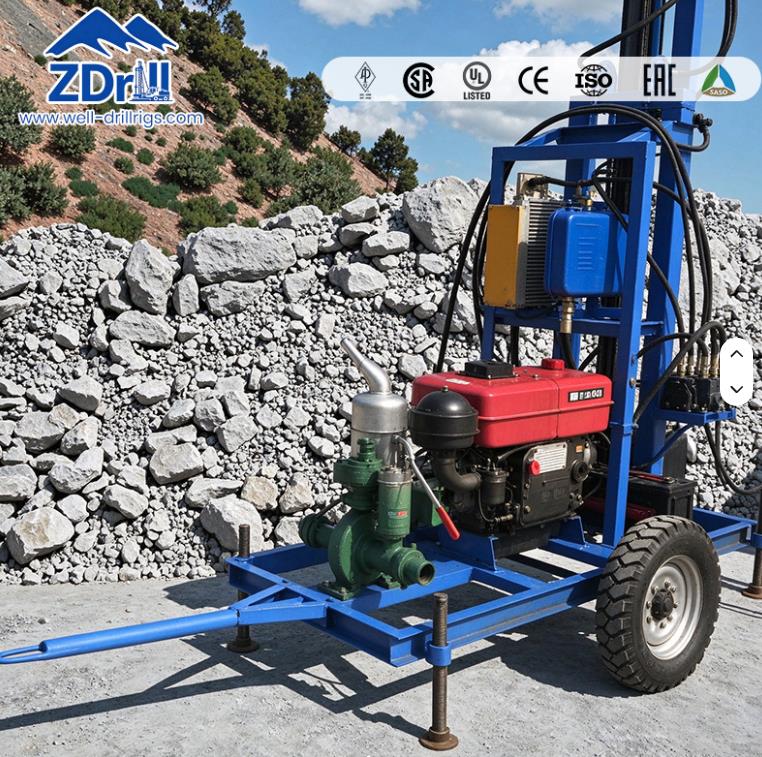
A sale listing describes a complete drilling package: the mast and hoist, the rotation or hammer system, the power unit, the circulation equipment and the chassis that carries it. On our product range, those packages are grouped by method and mounting rather than by a single model number.
Rotary mud rigs, pneumatic DTH rigs, core rigs and reverse circulation rigs all produce a borehole, but they suit different ground. A listing that does not name the method has not told you what the machine is built to do. Ask before you look at the price.
Most disagreements after purchase are not about the number on the invoice. They are about an assumption: a pump that was expected but not listed, a depth that was a target rather than a rating, or a chassis that cannot reach the site. Written specifications close those gaps.
Loose sand and gravel need mud circulation to hold the wall. Sound rock favours a pneumatic hammer. Fractured or gravelly ground may justify reverse circulation for cleaner samples. Match the method to a soil profile before you shortlist machines.
A cheaper rig that needs a dedicated carrier and a separate compressor can cost more than a higher-priced package that tows behind a truck. Add transport, site preparation and auxiliary plant to the comparison, not just the machine price.
Bits, seals and hoses are wear items. A supplier who lists recommended spares and answers a fault call quickly protects your drilling season better than a small discount on the initial unit.
Published ranges across our catalogue include rotary platforms covering 300-2000 m, crawler rigs with a standard 2000 m unit, and custom depth from 150 m to 2000 m on several families. Ask which figure applies to the exact build you are buying and whether it is a rating or a target.
Engine make, rated power, transport dimensions and shipping weight are not published on every category page. Mark each as "to be confirmed in writing" and request the values before you arrange freight or design a site pad.
Confirm the pump model, air demand and compressor arrangement. The published ZD200A crawler lists air consumption of 17-35 m³/min and working pressure of 1.7-3.0 MPa; the tractor rig lists 13-30 m³/min at 0.7-2.5 MPa. Those figures change the compressor you must budget for.
Some pages state a one-year warranty and a minimum order of one set. Ask what the warranty covers, which tools ship with the machine and whether training is part of the sale.
The rotary water well drilling rig family uses mud circulation for large-diameter bores in sand, gravel and mixed strata, with crawler, truck and trailer mounts.
For road relocation and small civil jobs, a trailer-mounted rig tows between sites. For farms with existing tractors, the tractor-mounted range keeps the carrier cost near zero.
Full-hydraulic crawler rigs suit rough ground and deep hard-rock wells, with published models from small pneumatic units to a 2000 m standard machine. Ask for the model list that matches your depth and formation.
Village and municipal wells often pass through layered alluvium. Rotary mud circulation keeps those layers open long enough to set casing and screen.
Farm bores need a diameter matched to the pump. The rig choice should follow the irrigation schedule, not the other way around.
Shallow and medium geothermal holes appear across the 300-2000 m rotary and deep crawler ranges. Confirm the delivered depth for the thermal target you have in mind.
Remote sites favour crawler mobility and pneumatic drilling. Plan the compressor, fuel and spare-parts stock before the rig arrives.
| Purchase Decision Matrix for Water Well Rigs | ||
| Criteria | Trailer-Mounted Unit | Crawler-Mounted Unit |
|---|---|---|
| Relocation | Tow between sites by road | Travels on rough ground under own power |
| Setup support | Hydraulic outriggers | Track stability on uneven ground |
| Typical use | Suburban and farm wells | Remote, deep and hard-rock wells |
| Auxiliary plant | Mud pump or compressor to suit | Compressor and hammer common |
| Cost driver | Lower carrier cost | Higher machine and transport cost |
| Confirm in writing | Tow spec and delivered depth | Climbing ability and delivered depth |
Neither column is universally cheaper. The right answer depends on where the wells are and what the ground is made of.
Send a soil profile or at least a description of the layers. A supplier who asks for this is more likely to specify the right method.
State the target diameter, depth and pump. These three numbers drive the rig, the circulation system and the casing plan.
Road network favours truck or trailer. Rough, remote access favours crawler. This decision changes cost more than most engine options.
Ask for the rig, pump, compressor, rods, bits and spares as separate lines. A single lump sum hides what is missing.
Check tag data against the written specification, watch the pump and hoist run under load, and confirm the training and spares plan about our contact and enquiry process.
Plan a level pad with room for the mast, the pipe rack and the circulation equipment. On a trailer unit, the outriggers need firm ground under each foot.
Level the chassis before raising the tower. Run the pump, rotation and hoist through a full cycle at handover, and record the serial numbers of major components.
Agree who supplies water, fuel and spoil removal. Confirm the operator training date, the recommended first-season spares and the response route for a breakdown.
We publish depth envelopes, diameters, weights and working parameters where the page provides them. Anything outside that list should be issued as a written specification, not an assumption.
Ask which components change for a custom build and request the revised specification. A named change is verifiable; a changed number is not.
Ask which wear parts are recommended for the first season and how they are shipped. Delivery training and on-site service should be stated in the quotation.
Confirm the escalation path for a fault and the availability of parts. Our after-sales service covers delivery training, on-site service, spare-part supply and regular visits.
We group machines by drilling method and mounting, which makes it harder to hide an unsuitable configuration behind a depth number. Our published ranges cover rotary, trailer, tractor, crawler, core and reverse circulation work, and we mark unpublished figures as items to confirm rather than filling them in. Shijiazhuang Zhengdrilling Machinery Equipment Co., Ltd. supports OEM and ODM builds for buyers who need a defined configuration, with spare-parts and technical support attached to the machine.
Confirm the method, delivered depth, diameter, pump, compressor, chassis and warranty in a signed specification. Match the method to a soil profile and demand a line-item quotation.
It depends on the model. The ZDSPJ rotary family publishes a 300-2000 m working range and several lines state 150-2000 m custom depth. Ask whether your exact build is rated or targeted, in writing.
Not necessarily. Air demand on our rigs ranges from about 13 m³/min on small pneumatic units to 55 m³/min on the RC machine. Confirm whether the compressor is included and what model is proposed.
Rarely well. Rotary mud circulation excels in loose ground, while pneumatic hammers excel in rock. Some crawler lines cover both with different tooling, but the method still changes. Choose for your dominant formation.
Normalise them to the same scope: rig, circulation plant, compressor, rods, bits, spares, training and freight. Remove any item not stated in writing, then compare the remaining like-for-like package.
Processing Demand Survey
x


