Shijiazhuang Zhengdrilling Machinery Equipment Co., Ltd.
Service Email: bruce@well-drillrigs.com
Bruce:+86-18603299555
 EN
 ES
 FR
 RU

Choosing an agricultural water well drilling rig is less about chasing the deepest rating and more about matching a borehole to a pump, a crop and a budget. The tractor-mounted machines in our agricultural water well drilling rig range were designed around a common farm reality: the well is one part of a working season, and the equipment must be ready to move between fields without a fleet of support vehicles.
We ask two questions before recommending a configuration. How much water does the irrigation schedule need per day, and how far is the rig from the nearest road? The first sets the borehole diameter and pump choice; the second decides whether a tractor-mounted or trailer package makes sense. Everything else follows from those answers.
An agricultural rig is a drilling package mounted so it can be moved by equipment already on the farm. The tractor-mounted version uses a conventional farm tractor for mobility, which removes the need for a dedicated carrier. Core parts are made of special steel for corrosion resistance, and the tractor chassis provides the stability needed for straight, repeatable holes.
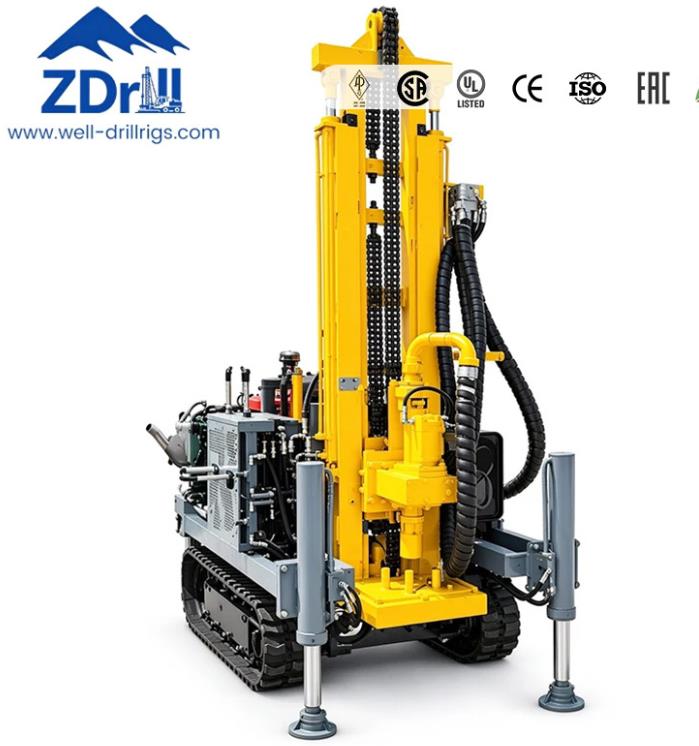
The published Tractor Rig 200 uses pneumatic drilling with a diesel power unit. Compressed air drives a hammer at the bit and lifts cuttings back up the annulus. On soft ground and small engineering wells, that simple loop keeps the rig light and fast to deploy.
A farm that drills one or two wells a year cannot justify a heavy crawler. Mounting the package on a tractor already in the yard spreads the cost across other tasks and keeps the capital tied up in the drilling unit alone.
Walking speed on the published parameter set is 30 km/h, with a climbing angle of 30°. The rig can move from a roadside to a distant field under its own tractor power, then set up without a separate haulage contract.
The Tractor Rig 200 lists drilling diameters of 60, 100 and 200 mm, with a second parameter set showing 90-235 mm. That spread covers small boreholes for stock water through to larger holes for irrigation pumps. Choosing the diameter against the pump, not against a maximum figure, protects the yield.
Double hydraulic motors supply torque, hydraulic legs give stable support, and an integrated control panel keeps the operator's adjustments in one place. Independent hydraulic heat dissipation, a low-carbon-steel body and a high-manganese-steel tower are listed on the product page. Optional hoist, welding machine, foam pump and mud pump let the same base unit cover different jobs.
One published configuration measures 3.4 × 1.5 × 2.2 m and weighs 3500 kg. A second set lists 3000 × 1350 × 2100 mm and 3.15 t. The difference reflects how the page presents two variants, so ask which dimension set belongs to the build you are quoted.
Standard maximum depth is 200 m, and the page states that depth can be customized from 150 m to 2000 m for different construction needs. Drilling diameter is listed as 60/100/200 mm and, in the second set, 90-235 mm. Confirm the delivered depth and diameter in writing for your formation.
The rig is listed as diesel powered, with working pressure of 0.7-2.5 MPa, air consumption of 13-30 m³/min, maximum torque of 4500 N·m, lifting force of 11 t and a boost speed of 40 m/min. Carriage travel is 1800 mm and minimum ground clearance is 400 mm. Adapted rock hardness is f=6-20.
A one-year warranty is stated on the page. We configure depth, diameter and auxiliary equipment around the well, and we treat any figure not printed on the product page as an item to confirm rather than a promise.
The tractor-mounted agricultural rig suits farms that already own a tractor and need to drill shallow wells, intake points and small hydrological survey holes. It is the lowest-overhead route into farm water development.
Where wells sit along a road network, a trailer-mounted water well drilling rig tows between sites and can carry a larger pump package. It trades some field agility for easier long-distance movement.
For deeper farm supply or geothermal use, the same engineering can be configured beyond the standard 200 m. Depth, chassis and auxiliary equipment are specified together, never as isolated upgrades.
Irrigation bores need a diameter that fits the pump and a screen interval that matches the aquifer. The rig's diameter range supports both small plot irrigation and larger commercial water supply.
Village and homestead wells are typically shallow to medium depth. A tractor-mounted package reaches them without building a permanent access track.
Before committing to a full well, many farms drill a survey hole to confirm the water table. The fast setup and pneumatic method make short investigation bores practical.
Orchards and stock operations need reliable, low-flow water across a wide area. Multiple shallow wells drilled with one mobile rig cost less than a single deep bore with extensive piping.
| Tractor-Mounted vs. Trailer-Mounted for Farm Work | ||
| Decision Point | Tractor-Mounted Rig | Trailer-Mounted Rig |
|---|---|---|
| Mobility source | Existing farm tractor | Towing vehicle |
| Published depth | Up to 200 m standard | 150-2000 m customizable |
| Published diameter | 60/100/200 mm and 90-235 mm | 90-700 mm customizable |
| Best fit | Several wells on one farm | Wells across a road network |
| Setup support | Hydraulic legs | Hydraulic outriggers |
| Main compromise | Road travel needs a tractor | Field access needs a tow vehicle |
The comparison is about where the wells are, not which machine drills faster. A single farm with clustered bores favours the tractor rig; a contractor serving several farms favours the trailer.
Select the diameter from the pump curve and the target flow. A 200 mm hole is wasted on a small stock pump, while an undersized bore throttles an irrigation pump for the life of the well.
The published adaptation range is f=6-20 rock hardness. Soft alluvium and fractured rock behave differently; tell the supplier what your soil profile shows before the air consumption and hammer are specified.
Because the page lists two size and weight sets, ask which one applies to your quote. A mismatch here affects transport planning and site access more than drilling performance.
Air consumption of 13-30 m³/min requires a correctly sized compressor. Budget for the whole system, not just the rig, and ask whether the compressor is included in the quotation.
Seals, bits and hydraulic hoses wear on seasonal machines. Ask which spares are recommended for a first season and how they are supplied about our service and spare-parts support.
Set the tractor on firm, level ground and deploy the hydraulic legs before raising the tower. Soft soil under a single leg can tilt the mast and produce an angled borehole.
The published design uses hydraulic leg support for loading and unloading. On slopes, use pads under the feet and check the mast with a level after the rig is positioned.
Allow space for the compressor, the pipe rack and the spoil from each rod. On a working farm, agree the traffic route with the operator so the rig does not block irrigation access during the season.
Ask which figures are measured and which are targets. We publish depth, diameter, size, weight and working parameters for the standard build; anything beyond that should arrive in a written specification.
Define what changes for a deeper rig: the mast, the hoist, the air system or the chassis. A supplier who lists the changed parts is configuring; one who only changes a number is quoting.
Ask for examples in comparable ground and climate. A rig that works in hard rock may be overbuilt and overpriced for shallow alluvial wells.
Confirm who trains the operator and who answers a fault call during harvest. Our support covers delivery training, on-site service and spare-part supply, with an OEM option for custom builds.
We treat the farm as the system. The tractor-mounted range is sized for real field access, the published diameters map onto common irrigation pumps, and the mobile chassis keeps one rig useful across several wells in a season. Depth and auxiliary equipment are configured around the borehole rather than sold as fixed bundles. Shijiazhuang Zhengdrilling Machinery Equipment Co., Ltd. also supports OEM and ODM builds about our product range for buyers serving rural water markets.
The standard published maximum is 200 m. The page also states that depth can be customized from 150 m to 2000 m for specific construction needs. Ask for the delivered depth of your exact build in writing.
It depends on the pump and the target flow. The Tractor Rig 200 lists 60, 100 and 200 mm, with a second set showing 90-235 mm. Match the diameter to the pump curve before you order.
Yes, it is designed to use a conventional farm tractor for mobility. Confirm the required tractor power and hitch arrangement in writing, since the page does not publish a tractor specification.
A one-year warranty is stated on the product page. Request the written terms, including which components are covered and how spare parts are supplied, before you sign the purchase order.
Only if your wells are spread along roads. A tractor rig suits clustered wells on one farm and uses equipment you already own; a trailer rig moves longer distances but needs a separate tow vehicle and field access.
Processing Demand Survey
x


