Shijiazhuang Zhengdrilling Machinery Equipment Co., Ltd.
Service Email: bruce@well-drillrigs.com
Bruce:+86-18603299555
 EN
 ES
 FR
 RU

A trailer mounted water well drilling rig is chosen for a reason that has little to do with drilling: the machine must move cheaply between sites that are already connected by road. Our trailer mounted water well drilling rig range puts the tower, pump and hoist on a towable base so a tractor or truck does the travelling and the rig does the drilling.
We plan the move before the borehole. If your wells are strung along a road network and each site needs a few days of work, towing beats a self-propelled carrier on cost. If the access track is soft or steep, the same machine becomes a liability. This guide covers what to check on both sides of that decision.
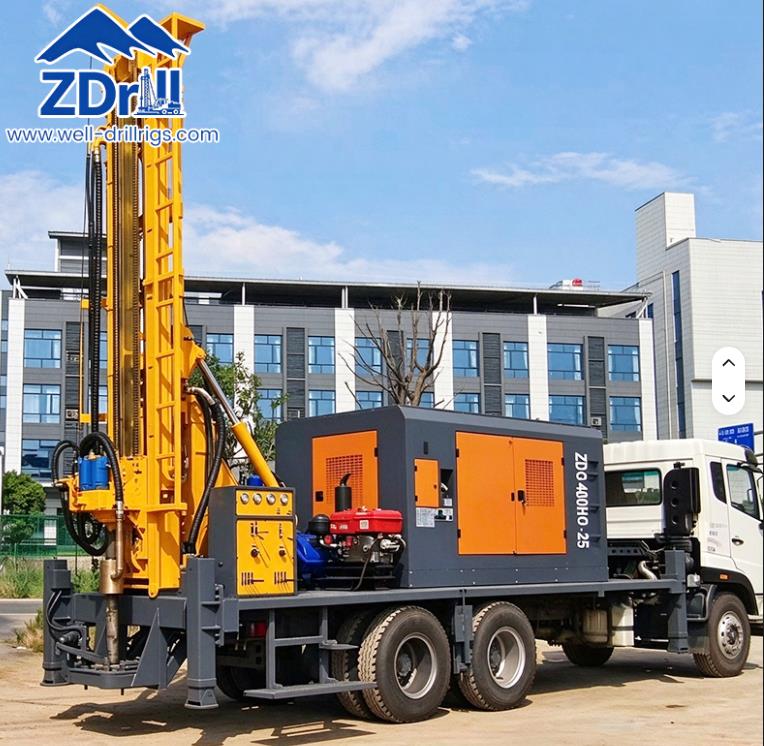
A trailer rig carries its drilling system on a dedicated trailer frame rather than on tracks or a truck. The published design uses special steel for key parts to resist corrosion, and an integrated frame for working stability. High outriggers support the unit during loading and unloading.
The page describes a full-hydraulic wheel DTH series used for rock holes, grouting holes and anchor cable work, as well as domestic and industrial water wells. Rotational speed, torque, thrust and pull pressure, feed speed and lifting speed can be adjusted for different formations. A drill pipe remover is fitted to speed rod handling.
A trailer mount is described as a low-cost option for short-distance relocation. You use a vehicle you already have and avoid the purchase and maintenance of a dedicated carrier.
The trailer base is built for convenient highway haulage. For contractors serving suburban potable wells and small civil water-source projects across a region, that mobility shortens the gap between jobs.
Hydraulic legs give stable support, and the compact frame suits farms, villages and construction sites. Once level, the rig drills a straight bore without the ground pressure issues of a heavy crawler on a small pad.
The rig can be equipped with a mud pump, foam pump, power generation and an electric welding machine. Optional hoist and other components let one base unit cover several job types without a second machine.
The page states a customizable drilling depth from 150 m to 2000 m, and a separate detail line gives 150-1000 m depth with 90-700 mm diameter. Because both figures are published, treat the delivered depth and diameter for your build as items to confirm in writing.
The unit uses a towable trailer base with high outriggers for loading and transport. The body is high-strength low-carbon steel and the tower is high-manganese steel, with independent hydraulic heat dissipation.
Rotation and feed parameters are adjustable from an integrated control panel. Double hydraulic motors provide torque. Engine make, rated power, transport dimensions and weight are not published on this page and should be requested in writing.
Depth, diameter and auxiliary equipment are configured around the project. We supply a complete design and production plan for water well engineering work rather than a fixed catalogue build.
The ZDSPJ1000 trailer-mounted drilling rig carries a diesel generator, large-displacement piston pump, double hoist, turntable, drilling tower and auxiliary unloading cylinder on one chassis. A tractor or truck pulls it between wells.
The WZD series is a full-hydraulic rock drilling machine used for water wells, grouting and anchor holes. Its adjustable hydraulic parameters make it useful where formations change within a single bore.
The mud pump option suits mud-circulation work in loose ground. Confirm pump model and capacity in the quotation, since the page lists it as an available accessory rather than a fixed inclusion.
Small domestic supply wells in settled areas are a core use. The compact footprint suits a restricted site and the trailer moves between jobs without a permit for a heavy carrier.
Farms with road access can tow the rig to a field, set up on a pad and drill an irrigation bore. The optional pump and foam packages cover both soft and hard layers.
Construction sites and municipal works use trailer rigs for temporary water supply and investigation bores. The high outriggers make loading and unloading straightforward.
The WZD series is listed for rock holes, grouting holes and anchor cable fixing in urban construction, railways, highways and hydropower work.
| Mobilisation Comparison: Trailer vs. Truck Mount | ||
| Factor | Trailer-Mounted Rig | Truck-Mounted Rig |
|---|---|---|
| Relocation method | Towed by tractor or truck | Self-propelled on highway |
| Relocation cost | Low, uses existing vehicle | Higher, carrier built in |
| Site access | Limited off-road ability | Better road speed, still needs a pad |
| Setup support | High hydraulic outriggers | Truck-level chassis and stabilisers |
| Best fit | Road-connected, short moves | Long highway distances between regions |
| Confirm in writing | Tow spec and delivered depth | Travel dimensions and delivered depth |
Choose on the route, not on the drill. The same drilling package can sit on either mount; the difference is how the rig earns its keep between jobs.
List the distance and road condition between sites. Short, frequent moves favour the trailer. Long highway legs may justify a truck mount.
Confirm the required tow vehicle, hitch and axle arrangement in writing. The page states the rig can be pulled by tractor or truck but does not publish a tow specification.
Published diameters reach 90-700 mm on the custom range. Select the diameter from the intended pump and formation rather than from the largest number available.
Decide between a mud pump and a foam or compressor package based on the ground. Ask which items ship with the rig and which are quoted separately.
Run the hydraulics, outriggers and pipe remover at handover. Our service and training support covers delivery training and on-site checks.
Level the trailer on firm ground and extend all outriggers before raising the tower. On soft ground, place pads under the feet so the rig does not settle during rod handling.
The high outriggers support loading and unloading as well as drilling. Check that the tow vehicle is detached and the trailer is fully supported before the mast is raised.
Allow space for the pump, foam or compressor package and the spoil from each rod. On village and farm sites, agree where the rig will stand so it does not block access during the job.
We publish the depth and diameter ranges, the steel construction and the adjustable hydraulic parameters. Engine data, weight and dimensions should be requested as a written specification for your build.
Ask which components change for a deeper or wider-hole configuration. A clear parts list is more useful than a revised headline number.
Ask for examples in comparable terrain. A rig that works on paved access may struggle on an unmade farm track, even with the same drilling depth.
Confirm spare-parts supply and fault response before you buy. A trailer rig often works far from a service centre, so the parts plan matters as much as the machine.
We design the trailer range around the way small contractors actually work: a towable frame, adjustable full-hydraulic control and a flexible accessory package. The published 150-2000 m depth range and 90-700 mm diameter range cover farm wells, suburban supply and small civil bores with one platform. Shijiazhuang Zhengdrilling Machinery Equipment Co., Ltd. supplies a complete design and production plan and supports custom builds about our company background for buyers building a regional fleet.
The page states the ZDSPJ1000 trailer rig can be pulled by a tractor or truck. It does not publish axle loads or hitch requirements, so confirm the towing specification in writing for your local rules.
The page gives a customizable depth of 150-2000 m and a detail range of 150-1000 m with 90-700 mm diameter. Ask which applies to your configuration and get the delivered figures in writing.
A mud pump is listed as an available accessory, not a fixed inclusion. Request a line-item quotation that states the pump model, capacity and whether foam or welding equipment is also fitted.
It needs a firm, level pad and deployed outriggers. On rough or steep access, a crawler mount is safer. The trailer's strength is road relocation, not off-road travel.
Level the rig, extend every outrigger onto firm ground, check the tower alignment and run the hydraulic functions before drilling. Confirm the operator training and spare-parts list at handover.
Processing Demand Survey
x


