Shijiazhuang Zhengdrilling Machinery Equipment Co., Ltd.
Service Email: bruce@well-drillrigs.com
Bruce:+86-18603299555
 EN
 ES
 FR
 RU

A crawler water well drilling rig is bought when the ground between jobs is as difficult as the hole itself. Tracks spread the load, keep the mast level on uneven ground and let the machine move under its own power to a remote well. Our crawler water well drilling rig range runs from small pneumatic units to a full-hydraulic machine with a 2000 m standard depth.
We look at two things before recommending a model: the terrain the rig must cross and the formation it must drill. A deep rating matters little if the access track cannot take the machine, and a small, agile rig is wasted on a deep hard-rock well. The published specifications help narrow the choice; the rest needs a written conversation.
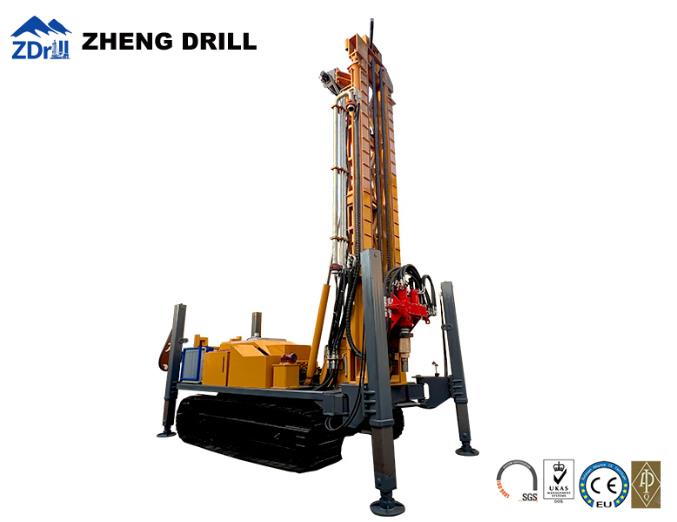
A crawler rig mounts the drilling system on a tracked chassis. The tracks provide mobility and a stable base on soft, uneven or sloping ground, while the hydraulic system drives rotation, feed, hoisting and travel. The result is a machine that can set up where a truck or trailer cannot reach.
Most models in this range use pneumatic DTH drilling: compressed air drives a hammer at the bit and carries cuttings up the annulus. The ZD-2000 is described as full-hydraulic, with all drilling movements controlled by hydraulic power and key structural parts made of special steel for corrosion resistance.
Track contact area keeps the rig from sinking and resists the side load of drilling on a slope. That stability translates into straighter holes and less time spent re-levelling the mast between rods.
For rural water projects, geothermal wells and mine supply bores, the well is often far from a road. A crawler reaches the pad without a separate access vehicle or a temporary track.
The published range includes a 2000 m standard machine and custom depths from 200 m to 2000 m across the family. That covers shallow domestic wells through to deep drinking water and industrial supply bores.
High-pressure pneumatic drilling and DTH hammers give the deep models strong rock-breaking performance. The ZD1600 is described as stable in deep hard rock, with powerful lifting capacity for deep strings.
The ZD200A hydraulic crawler rig has published figures worth listing in full because they set a clear baseline: drilling diameter 30-150 mm, maximum depth 80 m, working air pressure 1.7-3.0 MPa, air consumption 17-35 m³/min, lifting force 8 t, rotary torque 2000-3000 N·m, rotary speed 60-120 rpm and a 35 HP diesel engine. It weighs 1.5 t, travels at 2.0 km/h, climbs 20°, takes 1.5 or 2.0 m drill pipe and measures 2420 × 1300 × 1900 mm.
The ZD-2000 full-hydraulic crawler rig has a standard maximum depth of 2000 m and can be customized from 150 m to 2000 m. Special steel structural parts and a crawler chassis give it corrosion resistance and stability for rural water, irrigation, shallow geothermal and municipal foundation exploration.
ZD1600, ZD1200 and 1000S are described as high-power full-hydraulic pneumatic rigs for deep drinking water, geothermal and industrial wells. ZD800S and ZD300 to ZD400 cover medium-deep and farmland wells; ZD350 is listed with a Yuchai engine.
Engine make, transport weight and dimensions for most models, and delivered depth for custom builds, are not stated on the category page. Treat these as items to confirm in writing, along with the compressor needed for the published air demand.
The ZD-2000 and ZD1600 suit deep wells and hard rock where lifting capacity and high-pressure pneumatic drilling matter more than road speed.
The 1000S, ZD800S and ZD1200 cover medium-deep drinking water, farm deep wells and geothermal work, with DTH rock-breaking performance in complex formations.
The ZD200A through ZD400 group serves farmland intake, domestic wells and small engineering bores. Their published sizes and air demands make them a practical first crawler for smaller contractors.
Crawler rigs reach villages away from paved roads and drill the domestic wells that serve them. The ZD-2000 is listed for rural domestic water well construction.
Deep farm wells and irrigation bores benefit from pneumatic penetration in mixed soil and rock. The smaller ZD models are described for farmland water intake.
Deep drinking water, geothermal and large industrial supply wells use the high-power pneumatic models. Confirm the delivered depth against your thermal or flow target.
Mine water supply wells and municipal foundation exploration are listed applications for the ZD-2000 and ZD1200, where stable borehole forming matters on difficult sites.
| Mount Comparison for Difficult Sites | ||
| Factor | Crawler-Mounted Rig | Trailer-Mounted Rig |
|---|---|---|
| Off-road mobility | Tracks move under own power | Needs a firm track and tow vehicle |
| Ground pressure | Distributed over tracks | Concentrated at outriggers |
| Slope handling | ZD200A published at 20° climb | Limited by tow vehicle and level ground |
| Setup on uneven pads | Level with track position | Requires a prepared, level pad |
| Relocation cost | Higher machine cost, no carrier | Lower cost, uses existing vehicle |
| Confirm in writing | Climb ability and delivered depth | Tow spec and delivered depth |
If the well is reachable by road and the pad is level, a trailer rig is cheaper. If the approach is soft, steep or remote, the crawler earns its cost in access.
Note the slope, ground bearing and width of the access track. A 20° climbing figure on the ZD200A is a published limit, not a guarantee on wet clay.
Choose from the published families: compact pneumatic for shallow bores, full-hydraulic deep models for long strings. Ask whether a quoted depth is a rating or a target.
Air consumption ranges from 17-35 m³/min on the ZD200A to much higher figures on deep pneumatic models. Budget the compressor and fuel as part of the machine.
The ZD200A takes 1.5 or 2.0 m drill pipe. Confirm the rod length, connection and hoist capacity for the string you plan to run.
Run travel, rotation, feed and hoist under load. Our DTH drilling equipment and support teams can advise on the hammer and compressor pairing for your ground.
Position the tracks across the slope where possible rather than up it. On soft ground, use timber or mats under the tracks before drilling a deep hole.
Level the machine before the mast is raised, and recheck after the first rod is added. Hydraulic supports and the crawler frame work together to keep the bore vertical.
Plan space for the compressor, rod rack and spoil. On remote sites, confirm fuel, water and spare-parts stock before the rig leaves the depot.
We state the ZD200A parameters in full and publish a 2000 m standard depth for the ZD-2000. Demand the same level of detail for any model you are quoted, in writing.
Ask which mast, hoist, engine and air system change for a deeper build. A parts list can be checked; a single revised number cannot.
Ask for examples in similar terrain and rock hardness. A crawler that works on a firm pad may struggle on the wet, sloping track you have described.
Confirm parts availability and fault response for a remote site. Our service and spare-parts support covers delivery training, on-site service and spare-part supply.
Our crawler range is split by the job: compact pneumatic rigs for farms and villages, and full-hydraulic deep machines for hard rock and long strings. Published figures such as the ZD200A's 80 m depth, 30-150 mm diameter and 20° climb, and the ZD-2000's 2000 m standard depth, give buyers a real starting point. Shijiazhuang Zhengdrilling Machinery Equipment Co., Ltd. marks unpublished figures as items to confirm and supports custom builds about our factory and production for buyers with demanding sites.
The ZD-2000 has a published standard maximum depth of 2000 m, with customization from 150 m to 2000 m. The ZD1600 and ZD1200 target deep drinking water and geothermal wells. Confirm the delivered depth for your build in writing.
The ZD200A page publishes a 20° climbing capacity. Other models do not publish a figure. Treat slope limits as site-specific and confirm them against your ground conditions.
It depends on the model. The ZD200A lists air consumption of 17-35 m³/min at 1.7-3.0 MPa. Match the compressor to the hammer and the published air demand, and confirm what is included in the quotation.
Yes, with the right hammer and bits. The ZD200A is listed for domestic well drilling with pneumatic power, while larger pneumatic models are described for complex rock formations. Choose by hole diameter and depth as well as rock hardness.
Plan fuel, water and a spare-parts kit, check track tension and hydraulics daily, and agree a fault-response route before the machine is dispatched. Delivery training and on-site service should be in the sale.
Processing Demand Survey
x


