Shijiazhuang Zhengdrilling Machinery Equipment Co., Ltd.
Service Email: bruce@well-drillrigs.com
Bruce:+86-18603299555
 EN
 ES
 FR
 RU


A village well is judged at the tap, not at the drill site. If the pump cannot lift the daily volume, or the bore cannot accept the pump, the machine that drilled it becomes an expensive footnote. We plan rural supply from the water point backwards: demand first, then well count, diameter, depth and only then the ground water drilling machine that can reach the pad.
Published data for compact rigs gives us useful anchors: 180 m depth, 100–350 mm holes and pipe in 1.5, 2.0 or 3.0 m lengths. Shijiazhuang Zhengdrilling Machinery Equipment Co., Ltd. has built drilling equipment since 1997 and exports to rural and agricultural markets in several regions. We ask buyers to bring a demand estimate and a route description before we discuss horsepower.
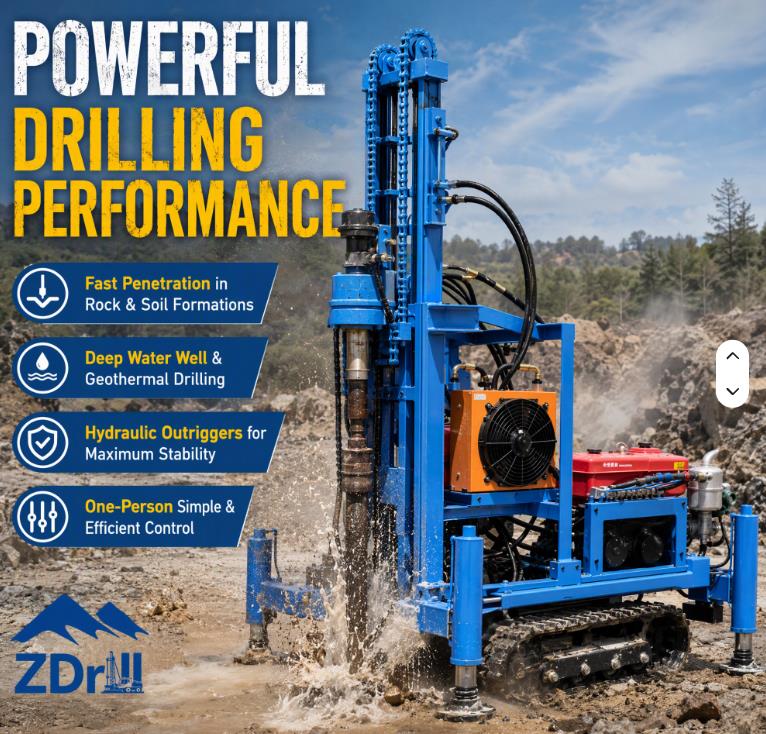
A ground water drilling machine is the rig, mast, power unit and drill string used to reach an aquifer. In rural work it is usually paired with a mud pump, a small compressor or a simple circulation pit. The machine is only one part of the water point you are building.
The rig rotates the bit while fluid or air clears the cuttings. Each rod adds length until the bit reaches the target formation. You then set casing, fit the pump and test the yield. The drilling step is short compared with the years the well must keep supplying water.
Start with litres per day and peak hours. A school, a farm and a household cluster place very different loads on one bore. Splitting demand across two smaller wells can be cheaper than drilling one deep bore that needs a larger pump.
A rural project should be sized from the water table and the producing layer. Published rig depth is a ceiling, not a target. Drilling far past a reliable aquifer wastes fuel, pipe time and casing money.
The pump goes in after the hole is finished. If the bore is too narrow, no amount of drilling speed helps. We fix the pump envelope early, then add casing clearance to set the drilled diameter.
Village tracks, wet fields and steep access roads stop more machines than hard rock does. A compact rig that can be walked or hauled in may beat a larger unit that waits at the roadhead for days.
The 100M–180M drilling rig figures list a 180 m maximum depth. The ZDL-260 is published at 260 m. Add a margin above the expected aquifer so a dry season does not leave you short.
The compact rig range covers holes from 100 to 350 mm. Wider bores cost more in fluid and cuttings handling, but they give the pump and casing room. Confirm the final diameter against your pump supplier before you sign.
Diesel options in the compact range are listed at 22 HP (16.41 kW), 25 HP (18.64 kW) and 35 HP (26.10 kW). Choose from the duty cycle, not the biggest number. Remote sites also need a realistic fuel delivery plan.
The ZDL-260 publishes a working pressure of 1.7–3.0 MPa, rubber tracks and hydraulic support legs. Pipe lengths of 1.5, 2.0 and 3.0 m are listed for the compact range. Match both to the mast stroke you will actually use.
| Published figures for compact ground water rigs | |||
| Specification | 100M–180M rig | ZDL-260 | Buyer note |
|---|---|---|---|
| Maximum depth | 180 m | 260 m | plan a margin above the aquifer |
| Hole diameter | 100–350 mm | to be confirmed in writing | match the pump envelope |
| Engine options | 22/25/35 HP (16.41/18.64/26.10 kW) | to be confirmed in writing | check fuel and service support |
| Working pressure | to be confirmed in writing | 1.7–3.0 MPa | check against the formation |
| Machine weight | 900 kg | to be confirmed in writing | ground bearing and transport |
| Drill pipe length | 1.5/2.0/3.0 m | to be confirmed in writing | mast stroke and rod handling |
Our portable water well drilling rig range covers shallow village and farm wells. These units suit sites where a truck cannot enter and the bore stays within compact depth classes. Colour can be customized on the 100M–180M models.
Crawler-mounted rig options carry more mast and pullback capacity. Rubber tracks and hydraulic legs help on muddy or hilly sites. We still ask for a route photo, because tracks do not solve every bridge or gate.
Where demand keeps growing, a rig in the 200 m class gives room for more wells and deeper aquifers. We confirm the exact configuration in writing rather than assume it from a model name. The choice should follow the water programme, not a resale guess.
A domestic point serves a few households or a village standpipe. The bore must stay simple to operate and easy to repair. Over-specifying the rig does not improve water quality, but under-sizing the pump guarantees complaints.
Farms need volume at specific seasons. We ask for the irrigation calendar, then size the well and the pumping duty together. A bore that works in the wet month may be asked for far more in the dry one.
Schools, clinics and small plants need a steady supply with little downtime. The drilling plan should include a spare pump strategy and a clear handover. The rig choice follows the well design, not the other way round.
Remote sites add fuel, access and spare-part constraints. A machine that can be maintained locally is worth more than a higher depth rating. We look at the supply chain for wear parts before we recommend a configuration.
Some buyers order a rig first and look for a site afterwards. That reverses the decisions that matter. The table shows what changes when the survey comes first.
| Survey-led planning versus buying first | |||
| Decision | Survey before purchase | Purchase before survey | Likely outcome |
|---|---|---|---|
| Well count | Daily demand sets wells and duty hours | One machine assumed sufficient | Under-supply or an idle rig |
| Depth class | Aquifer log sets the margin | Depth picked from a catalogue | Short hole or wasted over-drilling |
| Bore diameter | Pump envelope fixed first | Diameter chosen after drilling | Pump cannot fit the bore |
| Site access | Route walked and measured | Mount chosen on price alone | Rig cannot reach the pad |
A survey does not remove uncertainty. Aquifers vary over short distances and yields change with the season. It does turn a guess into a written assumption you can test, which makes the first bore a useful measurement instead of an expensive mistake.
Write down daily demand, peak hour flow and how many points must run at once. Add a modest growth allowance. Those three numbers drive well count, pump size and the diameter you need before any rig is compared.
Ask neighbours, drillers or the local authority for borehole logs and depths. A written record beats a verbal estimate. If nothing exists, plan a first hole that gathers data as well as water.
Measure gates, bridges, track width and slopes. Crawler, wheel and trailer mounts each solve a different access problem. A machine that cannot reach the pad has no useful depth rating.
These three figures are one decision, not three. A 180 m rig with a narrow hole may not suit your pump. Ask the supplier to confirm each number in writing against your casing and string plan.
Agree how the well will be tested and what yield counts as success. Record the method and the season. A bore accepted in a wet month may need a different pump when the water table falls.
Clear a pad large enough for the rig, the pipe racks and the circulation pit. Level the machine before the mast rises. On compact sites, poor leveling shows up as a crooked hole rather than an obvious fault.
Set casing to suit the finished diameter and the pump envelope. Leave room for the headworks and a meter. A well that is hard to service will be abandoned long before the aquifer runs dry.
Confirm power for the pump, a clean storage area for pipe and a protected place for spares. Dust and mud shorten the life of both the rig and the pump. Plan those areas before the crew arrives.
Ask which figures are published and which need confirmation. Depth, hole diameter, engine options and weight should be traceable. A supplier who marks the gaps in writing is easier to work with than one who fills them with guesses.
We accept special configurations and customized colours on compact models. Ask any supplier how local fuel, road size and climate affect the build. A standard machine is only standard in the conditions it was designed for.
Request the machinery test report for compact rigs and check that it matches the machine you are buying. Our regional project records show where rigs have worked, not what a single well produced. Treat both as context, not a yield promise.
A rural well is a long-term asset. Ask who trains the operator, which wear parts are stocked and how a field visit is arranged. Our delivery training and spare parts support sits in the same conversation as the machine.
ZDrill Machinery takes one brief from the water point back to the rig. We combine independent research, manufacturing, export and technical service, and we export drilling equipment to regions that include Central Asia, Africa, South America and Southeast Asia. For rural projects that means one contact for the machine and its support.
We will not promise an aquifer we have not seen. We will state what our published rigs can do, flag what needs written confirmation, and help you plan the handover. Send the demand estimate and the access route, and we will respond with a configuration and a list of open questions.
It depends on daily demand, peak flow and the yield of each bore. Start with users and litres per day, then compare that with a tested yield. Two moderate wells often beat one large bore, because a pump failure leaves half the supply running.
Depth follows the aquifer, not the rig catalogue. Use local borehole logs or a first investigative hole to find the producing layer, then add a margin for dry seasons. A 180 m compact rig is a ceiling, not a requirement for every village.
Sometimes, but diameter is the limit to check first. The compact range covers 100–350 mm holes. Compare that with the pump envelope and casing clearance before you order. A fast bore that cannot accept the pump has no value.
Yes. The 100M–180M models are listed with a Machinery Test Report and a one-year warranty. Colour can be customized. Ask for the report tied to the machine you are buying, and keep it with the handover file for later service work.
The pump and the access route. Buyers focus on the drill, then find the bore too narrow or the rig unable to reach the site. Include pump fit, spare parts and operator training in the same plan as the machine, and the well stays useful for years.
Processing Demand Survey
x


