Shijiazhuang Zhengdrilling Machinery Equipment Co., Ltd.
Service Email: bruce@well-drillrigs.com
Bruce:+86-18603299555
 EN
 ES
 FR
 RU

Depth is the first number buyers read and the last one that describes the job. At 1000 or 2000 metres, the string weighs tonnes, the hole needs cleaning on every connection, and a weak air supply can stop work even when the mast is tall enough. We ask buyers to tie each number on a rig sheet to a real moment down the hole.
Published figures give us a firm starting point. The ZD1600 deep water well rig lists 1600 m, 12,000–24,000 N·m of torque and 16–120 m³/min of air demand. Shijiazhuang Zhengdrilling Machinery Equipment Co., Ltd. has built drilling equipment since 1997. We will show you which of those numbers decide a deep well and which still need a written answer.
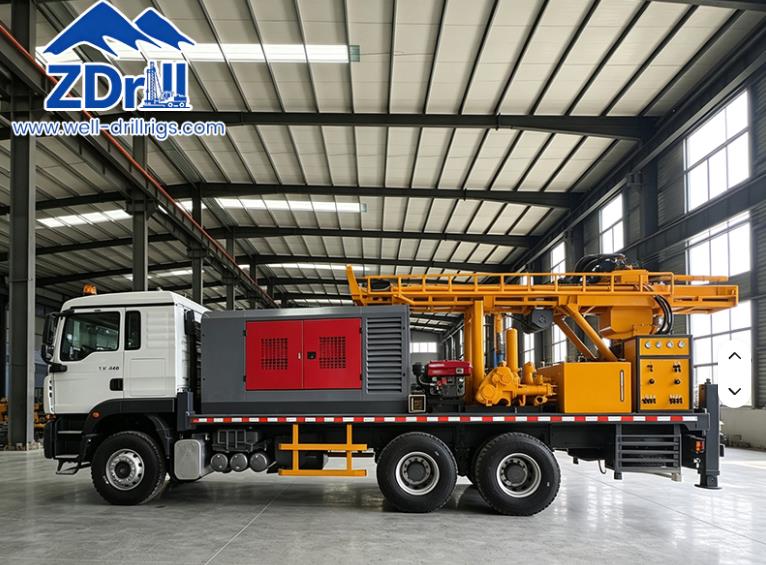
A deep water well drilling rig is a rotary or hammer machine designed to carry a long drill string and pull it back safely. Its mast, rotation head, winch and circulation system are sized together. A shallow rig with a bigger engine is not the same thing.
The rotary head turns the string while fluid or air lifts cuttings to the surface. Each connection adds pipe and adds weight. The rig must keep turning that weight, keep lifting it, and keep the hole clean at a depth where a small restriction becomes a serious event.
We ask buyers to name the moment behind each number: depth at the producing layer, torque at the bottom of the string, air at the hammer face. Ten specs deserve that test. A sheet that cannot answer it is a list, not a drilling plan.
Below 1000 metres, the drill string can weigh more than the rig itself. Lifting force decides whether a stuck tool can be recovered or becomes a lost hole. It matters more often than maximum depth does.
Deep holes generate long returns. If flow or pressure falls short, cuttings settle around the bit and penetration slows. Matching circulation to the method early is cheaper than adding a larger pump after mobilisation.
Mud rotary, DTH hammer and reverse circulation each suit different strata. A deep rig that can change method is more useful than one locked to a single technique. The formation, not the brochure, should make that choice.
The published ZD1600 rating is 1600 m with holes from 127 to 700 mm. The ZD-2000 full-hydraulic rig lists 2000 m with a 500 mm maximum hole. Treat both as machine limits and add a margin for your casing programme.
Torque of 12,000–24,000 N·m is published for the ZD1600, with rotation from 75 to 160 r/min. The ZD-2000 lists 38,000 N·m and 120–440 rpm. Ask what those figures mean with your full string and your bit, not at the surface.
The ZD1600 publishes 60 T of lifting force, 29 m/min quick lift and a 4 T main winch. The ZD-2000 reaches 100 T. Those numbers decide casing runs and stuck-pipe recovery, so compare them against the weight you plan to carry.
ZD1600 air demand is listed at 16–120 m³/min with working pressure of 1.65–8 MPa. Air figures for the ZD-2000 need to be confirmed in writing. Size the compressor from the hammer you will run, not from the rig's headline depth.
ZD1600 pipe is listed at 3–6 m length and 114/127/140 mm diameter. ZD-2000 pipe is 3 × 6 m at 102/114/127 mm. Our deep-well drill pipe options start from a Φ50–Φ127 mm general range, so confirm the exact string in writing.
The ZD-2000 publishes a 6.6 m mast stroke and 21 t machine weight. The ZD1600 lists a 20 t machine and 1.7 m outrigger stroke, but its mast stroke needs to be confirmed in writing. Both affect tripping time and pad preparation.
| Published figures for two high-depth rigs | |||
| Parameter | ZD1600 | ZD-2000 | What it changes on a deep well |
|---|---|---|---|
| Maximum depth | 1600 m | 2000 m standard | target you can plan for |
| Hole diameter | 127–700 mm | 500 mm maximum | casing and pump envelope |
| Maximum torque | 12000–24000 N·m | 38000 N·m | ability to turn a long string |
| Lifting force | 60 T | 100 T | stuck-pipe recovery and casing runs |
| Air demand | 16–120 m³/min | to be confirmed in writing | compressor sizing for hammer work |
| Engine power | 264 kW | 410 kW | fuel and power budget |
| Mast stroke | to be confirmed in writing | 6.6 m | tripping speed per connection |
| Machine weight | 20 t | 21 t | transport and pad bearing |
Crawler mounts carry the ZD1600 and ZD-2000 platforms. They suit sites where the pad is uneven or the access road is unimproved. The trade-off is slower highway movement, which matters if your crew drills several wells a month.
Our truck-mounted rig range covers 200–2000 m and offers established heavy-truck chassis options. Published T-series figures include 1000 m and 1200 m classes with lifting forces of 51 T and 60 T. Check road permits before you choose the mount.
Some deep jobs need mud circulation, others need DTH hammer or reverse circulation. We can discuss the rig with the method built into the specification, including mud pump, compressor, reamer or welding generator. Confirm which items are included in each quote.
Cities and plants need large volumes from confined aquifers. Deep bores need accurate diameter and casing design from the start. A mismatch here is expensive to correct after the hole is drilled.
When shallow layers fail, farms depend on deeper water. Yield, pump fit and depth must be agreed together. The rig needs enough diameter margin to house the pump that the irrigation system actually requires.
Shallow geothermal and municipal foundation water exploration often pass through mixed layers. The ZD-2000 is listed for loose layers and reverse bedrock layers using reverse circulation. Confirm the method against your own borehole log.
Remote sites add transport, fuel and spare-part constraints. A 20 t machine needs a prepared pad and a realistic hauling plan. Plan the logistics before you accept a depth rating that only works on paper.
A depth number tells you what a machine can attempt, not what it will finish. Deep wells fail at the weak link in the string, the air supply or the casing plan. This table puts the two purchase methods side by side.
| Depth-first purchase versus a spec-matched purchase | |||
| Decision | Buying on depth alone | Matching the full specification | Field consequence |
|---|---|---|---|
| String weight | Never calculated | Checked against lifting force | Stuck pipe becomes a lost hole |
| Air supply | Compressor added later | Air and pressure written with the rig | Hammer stops before target depth |
| Casing plan | Diameter assumed | Fitted to hole and pump envelope | Pump cannot enter the bore |
| Drilling method | One method assumed | Mud, DTH or RC matched to strata | Slow progress in hard rock |
A spec-matched purchase still depends on the formation you find. No sheet removes that risk. It does give you a clear record of what the rig was chosen to do, which makes a change of method a decision rather than a dispute about the machine.
Write next to each spec the point in the hole where it matters. Torque at total depth, air at the hammer, lifting force during a stuck-pipe pull. If a number has no moment, it is not driving your decision.
Add pipe, collars, bit and casing, then compare with the published lifting force. Include a recovery margin. A rig that can drill the hole but cannot pull the string is not a working rig.
Ask for the hammer model first, then its air consumption and operating pressure. Compare those with the rig's published demand and pressure range. Add hose losses and altitude before you sign a compressor order.
Start from the pump you must install, add casing wall and clearance, then set the drilled hole size. Compare with the rig's diameter range. This order prevents the most common deep-well regret.
Agree what the first hole must prove: depth, diameter, hole stability and circulation. Record the formation and method used. A clear trial is far cheaper than discovering a mismatch on a paid production well.
A 20 t machine needs a level pad with room for full outrigger extension. The ZD1600 publishes 1.7 m of outrigger travel. Soft fill under one leg can shift the mast and ruin alignment at depth.
Deep holes need a pit sized for long returns and a clear path from the outlet. Plan fluid storage and cuttings disposal before the first rod goes down. Poor returns show up first as slow penetration.
Check road width, bridge limits and grade before the rig moves. The ZD1600 travels at 3.5 km/h and climbs to 35°, while the ZD-2000 manages 2.5 km/h and 21°. Confirm fuel, power and water supply on site.
Ask which numbers are published and which are estimates. Depth, torque, lifting force, air demand and engine power should all be traceable. Where we have no published value, we mark it to be confirmed in writing.
We support OEM and ODM requests and accept special configurations. Ask any supplier to list what ships with the rig and what is an optional extra. On deep jobs, a missing pump or compressor changes the whole plan.
Request the test documentation for the exact machine offered. You can also review our company honours page for background. Evidence tied to the machine matters more than a general statement about experience.
Ask who supplies wear parts, who trains the crew and how field service is arranged. Deep wells are expensive to interrupt. A supplier with a written spares list is easier to plan around than a lower price with vague support.
ZDrill Machinery publishes the figures that drive deep-well decisions and marks the ones that need a written answer. We were founded in 1997 in Shijiazhuang, Hebei, and our equipment has been recorded in regional projects including a Nigeria 500 m bore and an Ethiopia 1000 m bore. Those records name regions where rigs were used; they are not yield guarantees.
We will not turn a single depth rating into a promise about your aquifer. Bring the casing programme, the string weight and the formation log. We will answer with torque, lifting force, air demand and pipe dimensions that can be checked line by line.
Depth is only the headline. Compare torque, lifting force, mast stroke and air demand as well. Published figures for the ZD1600 and ZD-2000 differ sharply on torque and lifting capacity. The right class follows your string weight and formation, not the number on the brochure cover.
No. Penetration depends on the formation, the method and how well cuttings are cleared. Published ZD1600 efficiency is 10–38 m/h under stated conditions. Ask which conditions apply before you compare that figure with another quotation.
Configurations exist for different methods, but you should confirm which ones are included in your quote. Mud rotary, DTH hammer and reverse circulation need different circulation equipment and tooling. Decide from the layers you will drill, then ask for a written list of what ships.
The ZD1600 page lists 114/127/140 mm pipe in 3–6 m lengths. Your final choice depends on string weight, connection strength and the torque applied at depth. Send us the proposed string and we will confirm what can be matched in writing.
Lifting force. Buyers compare depth and torque, then forget that the string must come back out. At depth, a stuck tool can weigh more than the rig can recover. Check lifting capacity against the full string and casing plan before you accept any quotation.
Processing Demand Survey
x


