Shijiazhuang Zhengdrilling Machinery Equipment Co., Ltd.
Service Email: bruce@well-drillrigs.com
Bruce:+86-18603299555
 EN
 ES
 FR
 RU

Your borehole does not care about the horsepower on a brochure. It cares about the first two metres of ground, then the next two hundred. Two plots a kilometre apart can defeat the same machine for opposite reasons. One clogs the bit with clay; the other shakes the mast in gravel. Before we discuss power, we ask for a soil sample, a borehole log, or a digger's account of the test pit.
We are Shijiazhuang Zhengdrilling Machinery Equipment Co., Ltd., and we build portable, crawler and truck-mounted rigs for groundwater, irrigation and domestic supply. Our range runs from compact 180-metre units to 2000-metre machines, but a bigger number on paper is not always better. This guide maps ground conditions to methods and shows where published data ends.
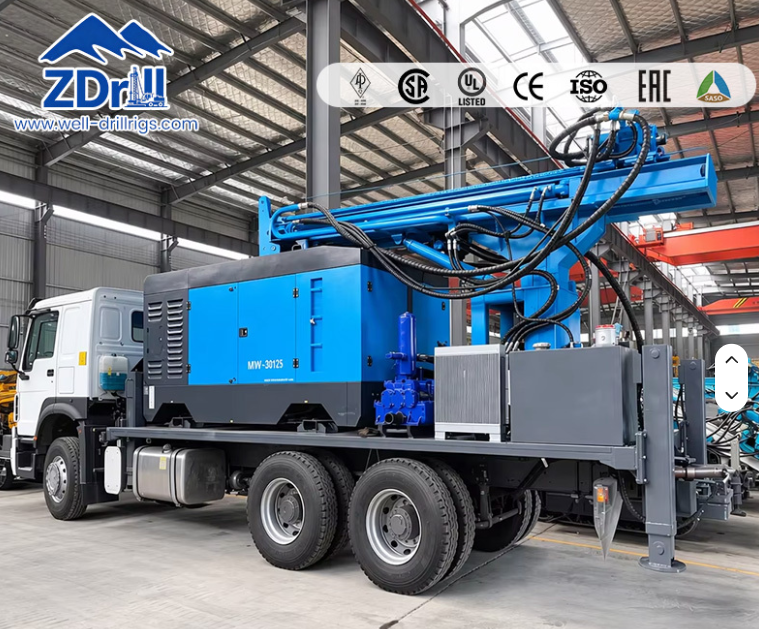
A drilling machine is a mast, a rotary head, a power pack and a drill string working as one unit. Crawler frames carry the mast over rough ground; wheels move faster on roads. Hydraulic legs level the frame before the bit touches soil, and that check decides whether the hole starts straight.
The head turns the pipe while thrust pushes it down. Mud or air carries cuttings out. In soft ground the bit cuts and the fluid holds the wall open. In rock, a hammer delivers the blow and air clears the debris. Change one part and the method changes with it.
Compact rigs reach places a truck cannot. A 900 kg machine with a 1850 × 800 × 1800 mm frame fits a farm gate and works in a courtyard. You trade depth for access. On village supply and shallow irrigation jobs, that trade wins.
Rotary mud drilling suits clay, sand and loose gravel because the fluid holds the wall open. A down-the-hole hammer suits hard rock. A rig that switches between them avoids buying twice. We ask which layers lie in the first hundred metres before recommending a path.
A smaller machine costs less to move and repair. It finishes shallow wells faster because setup takes minutes, not hours. The limit is real: past 260 metres or 350 mm diameter, a compact frame stops being economical.
Ask for a supervised first hole with agreed acceptance terms. The trial shows whether the mast stays level, whether cuttings clear and whether the planned pipe fits. A catalogue cannot answer those questions. A half-day on site can.
Our 100M, 150M and 180M models share a published maximum depth of 180 metres and a hole range of 100–350 mm. That covers most domestic and small irrigation wells. Deeper targets need a different rig, and we will say so rather than stretch a number.
Three diesel options appear on the compact line: 22HP (16.41 kW), 25HP (18.64 kW) and 35HP (26.10 kW). Power matters when the hole is deep or the ground dense. The rubber-tracked ZD260 publishes a working pressure of 1.7–3.0 MPa.
The compact line uses 1.5, 2.0 and 3.0 metre drill pipe sections. Shorter sections suit tight compounds; longer ones cut connection time on open sites. Our wider range runs from Φ50 to Φ127 mm. Confirm thread and diameter before ordering spares.
A 900 kg machine shifts with a small loader and needs no paved haul road. Rubber tracks spread the load on soft ground. Hydraulic legs on the ZD260 level the frame on a slope. Write the access route into your enquiry.
We supply a Machinery Test Report with the compact rigs and a one-year warranty on that line. Colour can be customized. Torque figures, acceptance conditions and spare-part lists should be agreed before payment, not found at delivery.
| Published figures for compact and portable rigs | ||||
| Model | Maximum depth | Borehole diameter | Power or pressure | Other published figure |
|---|---|---|---|---|
| 100M-150M-180M | 180 m | 100–350 mm | 22/25/35HP | 900 kg; pipe 1.5/2.0/3.0 m |
| ZD260 | 260 m | to be confirmed in writing | 1.7–3.0 MPa | rubber tracks; hydraulic support legs |
| ZDL200 | 200 m class | to be confirmed in writing | 58 kW diesel | lifting 12 T; torque 3200–4600 N·m |
| ZDL-300 | to be confirmed in writing | to be confirmed in writing | to be confirmed in writing | selection by geology and method |
Our compact 100–180 metre rigs run on tracks or wheels and cover domestic wells, small farms and courtyard jobs. Wheels suit road moves; tracks suit wet ground. The frame stays at 900 kg, so a small trailer moves it. Published depth stops at 180 metres.
For 200–260 metre wells, the ZDL200 and ZD260 add lifting force and pressure. The ZDL200 publishes 12 T lifting force and 3200–4600 N·m of torque from a 58 kW diesel. Those numbers matter when the hole carries casing.
The ZDL-300 portable rig sits in the same family, but its detailed figures need written confirmation. We treat it as a site-specific choice: geology, hole diameter and method decide whether it fits. Ask us for the configuration sheet.
Village wells are often shallow, narrow and behind gates a truck cannot pass. A compact rig with a short mast works here. The main risk is a poorly sealed annulus, so agree the casing plan before drilling starts.
Irrigation wells need diameter as much as depth. A pump must fit the finished hole with room for the intake. A 100–350 mm range gives that room on many farms. Check the pump first, then choose a rig that can cut that hole.
Site investigation holes are shallow but numerous. A portable rig moves between positions quickly and disturbs less ground than a large crawler. You may need core tools rather than a water well bit. Tell us the sampling method.
Where bedrock appears, rotary bits slow down. A down-the-hole hammer rig changes the economics. Air demand and pressure become the limits, not engine power. Our ranges cover both methods; confirm the compressor match in writing.
Engine power is easy to print and compare. It is also the weakest predictor of whether a hole reaches water. The table sets a power-first purchase against a ground-first one across the decisions that change on site.
| Ground-first selection against power-first selection | |||
| Decision point | Choosing on engine power | Choosing on ground profile | What to ask us |
|---|---|---|---|
| First two metres | Rarely sampled | Sample or log required | Send a soil sample |
| Drilling method | Fixed by the machine | Changed with the formation | Confirm mud or DTH |
| Spare drill pipe | A single assumed size | Matched to hole and casing | State diameter and thread |
| Acceptance | Headline depth only | Trial hole with agreed terms | Put terms in the quote |
Power still matters. It decides how fast the bit turns under load and whether the rig pushes through a dense layer. Treat it as one line in a specification, not the whole specification. Fill in the right-hand column.
Clay sticks. Sand collapses. Gravel abrades. Each punishes a different part of the string. A bucket from a test pit tells you more than a horsepower table. If the first two metres are mixed, plan a method change inside the hole.
Depth gets the attention; diameter decides the pump. Write down finished hole size, casing outside diameter and pump body. Then add clearance. A rig rated for 350 mm is no help if your screen needs a larger annulus.
Measure gates, overhead wires and turning space. A 15.5 metre rotary mast needs room a 1.8 metre compact unit never asks for. Tracks help on mud; wheels on tarmac. Choose the frame your site has.
Mud circulation suits loose ground and carries cuttings well. Air and hammer work better in rock. Reverse circulation gives cleaner samples. Ask what the rig can switch to without buying a second machine.
Agree the test conditions attached to any depth claim. State the formation, hole diameter and pipe used. Add what happens if the trial misses target depth. We would rather argue about a clause before production than after delivery.
On uneven ground, extend the hydraulic legs before lifting the mast. A mast that leans at the start drifts with every pipe connection. Recheck levels after ten metres.
Place the mud pit or compressor where the return line reaches it without a long run. Keep suction away from the rig. Confirm generator output and cable length on site. A clean layout saves an hour per shift.
Write the transport dimensions into the contract. Our recorded projects span remote and rural sites, and access often decides the configuration. A regional borehole case record shows how a rig reaches a working site. Ask for delivery training with the order.
Send the log with your enquiry. It lets us name a method instead of guessing. With no log, describe what the neighbour's well passed through. A rough profile beats a blank RFQ and saves both of us a round of emails.
One rig rarely covers every formation. If most work is shallow clay, buy for that and hire a hammer rig for rock. If your region is mixed, pay for a switchable machine. Be honest about the split; we will not push a larger frame.
The compact line ships with a Machinery Test Report. Match it to the serial number on the machine you receive. Keep copies in the buyer file with the configuration sheet. That habit pays off when you order wear parts.
Drill pipe, bits, compressor and pump can cost more than the gap between two rigs. Ask each bidder to list what ships with the machine. A lower rig price with an undersized compressor is not a lower package price.
We publish the figures we can stand behind: 180 metres on the compact line, 260 metres on the ZD260, 3200–4600 N·m on the ZDL200. Where a number is not public, we mark it to be confirmed in writing. We ask for your ground profile before quoting, because a wrong match costs more than a wrong price.
Our service covers pre-sale technical questions, delivery training, on-site service, vehicle maintenance and spare-part supply, plus free spot checks and return visits. If your site is hard to reach, send the access route. We will tell you which rig fits.
Not necessarily. Published depth ratings assume conditions that must be stated in writing. In rock, the bit, hammer and air supply decide progress before the mast does. Ask for the test conditions attached to the rating and compare them with your borehole log.
Send a soil sample or borehole log, target depth, finished hole diameter and the pump you plan to install. Add the access route and height limits. With those five items we can name a rig instead of a range of guesses.
No. A heavy crawler gives stability and depth but needs road access and setup time. On small plots, a 900 kg compact unit often finishes more holes per day because it moves quickly. Productivity depends on hole count and ground.
The 100M–180M machines are published with a one-year warranty, a Machinery Test Report and customizable colour. Ask us to list the documents that ship with your order and match the serial number on arrival. Put other terms in the contract before payment.
Watch the cuttings and the rate of penetration. When the bit stops advancing in rock and the return shows hard fragments, mud rotary has reached its limit. A hammer needs more air and a different bit. Plan that change in the original specification.
Processing Demand Survey
x


