Shijiazhuang Zhengdrilling Machinery Equipment Co., Ltd.
Service Email: bruce@well-drillrigs.com
Bruce:+86-18603299555
 EN
 ES
 FR
 RU

A rig rated for deep wells is not automatically right for a shallow well in loose gravel. Buyers often choose the depth first and discover the mistake at the yard. The hole is too small for the pump, or the machine cannot reach the pad. We are a China factory, and we split the decision into depth, diameter and chassis. Ask which road or track your site actually has.
Depth, hole diameter and mobility are three separate choices that change the quote. Published figures give you a starting point, not a promise. Our range includes crawler, truck-mounted and trailer-mounted rigs, and we show the numbers behind each one. This guide looks at the three decisions from the factory side. Send your access route with the RFQ and ask for a written configuration.
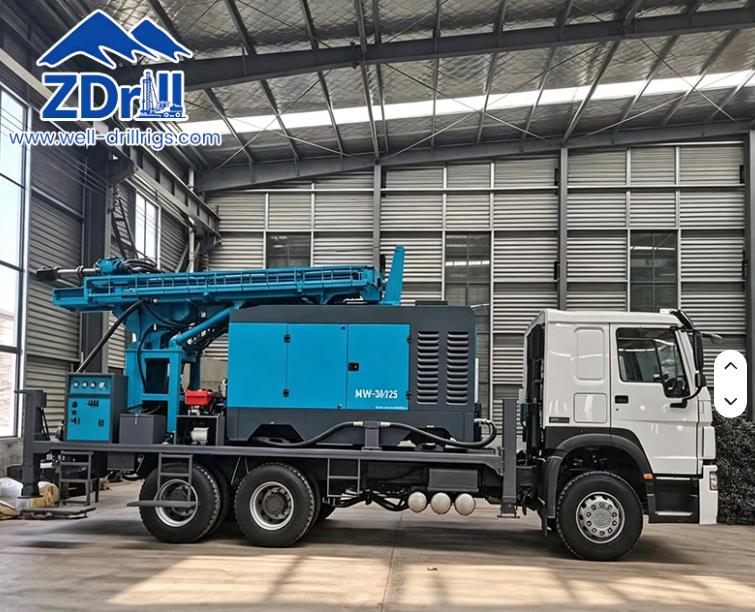
A drill rig carries a mast, a rotary head, winches and a power unit on one chassis. Outriggers hold it level while the string turns. The chassis decides where the machine can work; the mast decides how deep it can go. We build rigs on crawler, truck and trailer mounts.
The head turns the pipe while the mast controls feed and pull. Circulation clears the cuttings by mud, air or reverse flow. The ZD-2000 is published as a reverse circulation rig. Method and diameter set the duty, so read them before the depth number.
Depth sells rigs, but diameter and chassis keep them working. We ask buyers to separate the three before they compare prices. A machine with a high rating and the wrong mount stays parked. A written configuration prevents that outcome.
Our product routes cover rural domestic wells, agricultural irrigation, shallow geothermal and municipal foundation water exploration. Each one asks a different question of the rig. Start with the job and the ground, then choose the machine.
We publish numbers for individual models, including depth, diameter, torque and lifting force. You can put them side by side and ask how each was measured. Where a figure is absent, mark it to be confirmed in writing.
Buyers get a better answer when a factory shows three mounts and asks about the access route. We do that at the enquiry stage. It costs less than discovering a transport problem after production.
The ZD-2000 crawler specification publishes 2000 m maximum depth and 500 mm maximum diameter. Depth can be set from 150–2000 m with a full design and production scheme. State your target and your casing before you accept that rating.
| Published rig comparison from our catalogue | |||
| Rig | Maximum depth | Hole diameter | Lifting force |
|---|---|---|---|
| ZD-2000 crawler | 2000 m | 500 mm | 100 T |
| ZDSPJ1000 trailer | 1000 m | 500 mm | 510 kN main winch |
| T-1200 truck | 1200 m | 105–900 mm | 60 T |
The ZD-2000 publishes 38000 N·m maximum torque and 120–440 rpm. Torque matters when the hole turns or the layer changes. Ask how the rating is measured and what pipe it assumes.
Lifting force pulls the string out when the hole fights back. The ZD-2000 lists 100 T and a 6.6 m mast stroke. Compare that with your full drill pipe weight, not with an empty hole.
The ZD-2000 uses 3 × 6 m pipe at 102, 114 or 127 mm, with a 410 kW engine. Travel speed is 2.5 km/h and gradeability 21°. Confirm the pipe and power package in writing.
The ZD-2000 is 21 t at 6800 × 2500 × 3000 mm. The ZDSPJ1000 is longer at 16700 × 2480 × 4100 mm. Measure your gate and turning circle before the machine ships.
Crawler rigs suit muddy, uneven sites. The ZD-2000 is a crawler machine built for loose layers and reverse bedrock layers. You give up road speed for stability on the pad.
Truck rigs cover 200–2000 m and accept established heavy-truck chassis options. Our truck-mounted rig options switch between mud drilling and DTH work. They need a firm road and a level site.
Trailer rigs suit buyers who tow between nearby wells. The ZDSPJ1000 trailer rig is published at 1000 m with a 15.5 m mast. Confirm the towing vehicle and the unloading plan.
Village wells often sit in soft layers at moderate depth. A crawler rig can reach the pad without a road. Ask for a sample of the first two metres before you size the machine.
Irrigation wells need a diameter that fits the pump. The ZD-2000 is used for agricultural irrigation wells and shallow geothermal work. Match the hole to the duty, not to the catalogue.
Municipal foundation water exploration asks for a documented hole and a stable rig. Reverse circulation suits loose layers and reverse bedrock layers. State the method in the contract.
Geothermal wells add casing and temperature to the depth question. Our deep routes and the ZD-2000 cover those jobs. Confirm which figures are published and which need written approval.
Depth is the easiest number to compare and the weakest one to trust alone. We would rather you decide diameter and chassis at the same time. The table sets a depth-only choice against a three-decision choice.
| Choosing on depth only versus three separate decisions | |||
| Factor | Depth-only choice | Three-decision choice | Payoff |
|---|---|---|---|
| Hole diameter | Assumed from the catalogue | Matched to casing and pump | Fewer re-runs |
| Chassis | Picked by habit | Matched to the access route | Rig reaches the pad |
| Confirmation | Verbal answer | Written configuration sheet | Auditable quote |
| Method | Not discussed | Named for the formation | Fewer changeovers |
A higher depth rating cannot fix a hole that is too narrow or a rig that cannot reach the site. We ask buyers to write the three decisions on one page. That page becomes the basis of the quote.
Start with the water you need and the depth it sits at. A deeper rating adds cost without adding yield. Record the target and the margin you want before you shortlist a rig.
Choose the finished diameter and the casing string. Diameter drives torque, air and pipe size. Write both down so every bidder prices the same hole, not their own assumption.
Loose layers and bedrock ask for different methods. The ZD-2000 is published for loose layers and reverse bedrock layers. Give the factory a log before they recommend a machine.
Describe the last kilometre to the pad, not just the highway. Crawler, truck and trailer mounts each solve a different access problem. Decide from the route you actually have.
| Chassis decision matrix for a water well drill rig | |||
| Mount | Best site condition | Published example | Trade-off |
|---|---|---|---|
| Crawler | Muddy or uneven ground | ZD-2000, 2000 m | Slower road travel |
| Truck | Highway moves between sites | T-series, 200–2000 m | Needs a firm pad |
| Trailer | Short hauls with your own tow vehicle | ZDSPJ1000, 1000 m | Tow unit required |
Keep one sheet with depth, diameter, chassis and method. Mark anything unpublished as to be confirmed in writing. A factory that answers in that format is easier to audit.
Level the pad and allow room for the mast and pipe storage. The ZD-2000 has a 6.6 m mast stroke. Confirm what your ground needs under the outriggers before delivery.
Check the engine data and the fuel plan on site. Our published figure for the ZD-2000 is 410 kW. Any electrical detail not on the sheet stays to be confirmed in writing.
Run a trial hole with the agreed diameter and method. Before the trial, send your route and soil profile and we will confirm the configuration in writing. Agree what counts as a passing result.
Ask for depth, diameter, torque, lifting force and transport size on one sheet. We publish those figures for our rigs. If a number is missing, treat it as to be confirmed in writing.
We support OEM and ODM solutions and customized colours on compact models. Put every option on the configuration sheet with a named owner. Scope written late costs more.
Ask for the machinery test report with the serial number behind it. A report from another formation proves less. Where a trial is possible, use your own ground.
Check the spare-part list, training and on-site service before you pay. Our service includes vehicle maintenance and periodic return visits. Ask who covers each item.
Shijiazhuang Zhengdrilling Machinery Equipment Co., Ltd. was founded in 1997 in Shijiazhuang, Hebei, China. We handle independent research and development, intelligent manufacturing, global export and one-stop technical services for drilling rig equipment. Our markets include Central Asia, the Middle East, Russia, South America, North America, Africa and Southeast Asia. You can read our company background and see the design work behind the range.
We answer an enquiry with a chassis choice and a written configuration. That is easier to audit than a quote that only lists depth.
Not on its own. Diameter, casing and chassis decide whether the rig fits the job. The ZD-2000 publishes 2000 m and 500 mm with reverse circulation. Send your target depth and hole size, and we will confirm the configuration in writing.
It follows the access route. Crawler mounts suit rough ground, truck mounts suit highway moves, and trailer mounts suit short hauls. We publish examples for all three. Describe the last kilometre to the pad with your RFQ.
Maximum depth 2000 m, maximum hole diameter 500 mm, 100 T lifting force, 38000 N·m torque and a 6.6 m mast stroke. It runs at 120–440 rpm on a 410 kW engine. Those figures are a starting point, not a site result.
Yes. The ZD-2000 can be set from 150–2000 m with a full design and production scheme. Put the chosen depth on the configuration sheet. Any figure outside the published range must be confirmed in writing.
Send the soil profile, target depth, finished diameter and the route to the site. We will reply with a chassis choice and a written configuration. A factory that answers in that format gives you something to compare.
Processing Demand Survey
x


