Shijiazhuang Zhengdrilling Machinery Equipment Co., Ltd.
Service Email: bruce@well-drillrigs.com
 EN
EN ES
ES FR
FR RU
RU
A Reverse Circulation Drilling Rig is designed for drilling projects where efficient penetration and rapid return of rock cuttings are important. Unlike conventional rotary drilling systems that return drilling fluid and cuttings through the annular space, reverse circulation drilling uses dual-wall drill pipes to create a dedicated return path for drilled material.
This drilling method is widely associated with mineral exploration, geological investigation, water well drilling and other projects where drilling speed and representative cuttings collection are important.
ZDrill Machinery provides Reverse Circulation Drilling Rig solutions for mineral exploration, geological investigation, water well drilling and foundation engineering. Its current product information indicates that RC drilling systems can be developed in approximately the 300–1500m range, depending on project requirements and configuration.
For international drilling contractors, selecting an RC rig should involve more than comparing maximum drilling depth. Formation, sample requirements, hole diameter, air consumption, drilling tools, mobility and supporting equipment all affect the final configuration.
A Reverse Circulation Drilling Rig uses a dual-wall drilling system to transport drilled cuttings back to the surface through the inner pipe.
During drilling, compressed air is introduced into the drilling system. The air assists in lifting cuttings through the inner tube while the outer section of the dual-wall drill pipe provides the drilling-fluid or air path.
The basic process can be summarized as:
Drill bit → rock fragmentation → compressed air → cuttings lifted through inner tube → surface separation → sample collection
This arrangement gives RC drilling a different operating principle from conventional rotary mud drilling.
The primary objective is often to obtain a continuous flow of representative rock cuttings while maintaining efficient penetration.
The RC drilling process involves several interconnected components.
The drilling rig provides:
Rotary power
Feed force
Hoisting capacity
Drill-string handling
Hydraulic control
Machine mobility
The rig must provide sufficient torque and lifting capacity for the selected drill-string configuration.
Dual-wall drill pipes are one of the defining components of an RC drilling system.
The two-wall structure creates separate flow paths within the drilling system.
This allows compressed air to assist in transporting cuttings through the inner tube rather than relying on conventional annular return flow.
The RC Hammer and bit break the formation during pneumatic drilling.
The hammer must be matched with:
Drill pipe
Air compressor
Borehole diameter
Formation
Required drilling depth
Incorrect matching between these components can reduce drilling efficiency and increase tool wear.
Compressed air provides the energy required for pneumatic drilling and cuttings transport.
The required compressor capacity depends on:
Hammer specification
Borehole diameter
Drilling depth
Formation
Air pressure requirements
Drilling system configuration
ZDrill's published RC rig information lists air consumption of approximately 16–55 m³/min for its 500m crawler RC configuration.
At the surface, the returning cuttings can be directed through a cyclone or similar separation system.
The separator helps separate the rock cuttings from the returning air stream so that samples can be collected and examined.
Mineral exploration often requires information about what is present below the surface.
In an exploration program, drilling may be used to identify:
Rock types
Mineralized zones
Formation changes
Geological structures
Overburden thickness
Approximate distribution of target materials
A conventional core drilling system produces relatively continuous cylindrical rock samples.
An RC system normally produces fragmented rock cuttings.
This difference is important when deciding between RC Drilling and Core Drilling.
If the exploration program primarily requires rapid cuttings sampling over many drilling locations, RC drilling can be considered.
If detailed structural information and continuous rock samples are required, core drilling may be more appropriate.
These two drilling methods are often compared in mineral exploration projects, but they serve different sampling objectives.
| Feature | Reverse Circulation Drilling | Core Drilling |
|---|---|---|
| Sample type | Rock cuttings | Continuous rock core |
| Main objective | Rapid sampling | Detailed geological analysis |
| Main tooling | RC hammer and bit | Core barrel and core bit |
| Drill pipe | Dual-wall pipe | Core drilling rods |
| Sample form | Fragmented | Cylindrical core |
| Sampling speed | Generally designed for rapid sampling | Focused on controlled core recovery |
| Typical application | Mineral exploration, grade-control programs | Detailed mineral exploration |
| Air requirement | Important for pneumatic RC drilling | Depends on drilling system |
ZDrill's own technical content distinguishes the two methods by sampling objective: RC drilling returns rock cuttings, while core drilling is designed to recover relatively continuous core samples.
Therefore, an exploration company should determine the required sample type before selecting the drilling rig.
Although RC drilling is strongly associated with mineral exploration, it can also be used for selected Water Well Drilling projects.
This is particularly relevant when the project involves:
Hard rock
Gravel
Fractured formations
Deep-hole drilling
Pneumatic drilling
Rapid penetration requirements
ZDrill describes its RC drilling system as suitable for hard rock, gravel, fractured formations and complex geological conditions, with applications including water well drilling.
However, RC drilling should not automatically replace rotary mud drilling or conventional DTH drilling.
The formation and well-construction requirements should determine the appropriate method.
Geological conditions can change significantly within the same borehole.
A drilling project may encounter:
Soil → weathered rock → gravel → fractured rock → hard rock
This can make equipment selection more complicated.
In harder formations, pneumatic drilling with an RC hammer can provide a drilling approach designed specifically for rock penetration.
In fractured formations, the drilling system also needs to account for cuttings removal and potential air loss.
For this reason, the Reverse Circulation Drilling Rig, air compressor, hammer, drill pipe and bit should be evaluated as one system rather than as independent products.
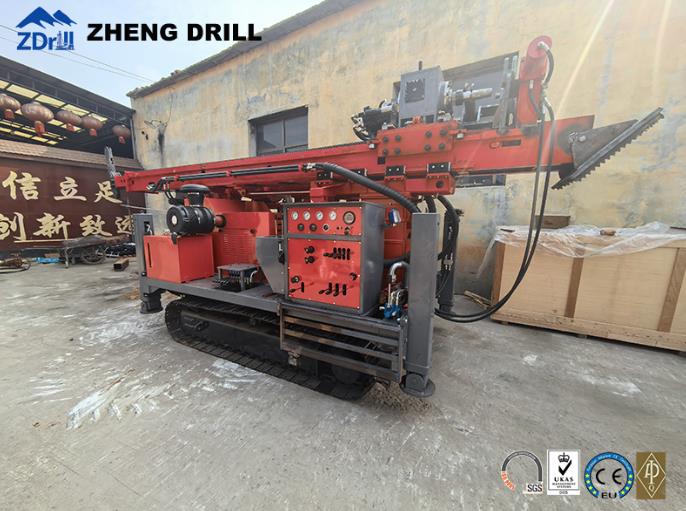
ZDrill currently lists a Crawler RC Reverse Circulation Drilling Rig with a maximum drilling depth of 500m.
Its published specifications include:
| Specification | Published value |
|---|---|
| Maximum drilling depth | 500 m |
| Hole diameter | 130–250 mm |
| Maximum opening diameter | 105–400 mm |
| Rotary torque | 5,000–10,000 Nm |
| Air consumption | 16–55 m³/min |
| Engine | Cummins |
| Power | Diesel |
| Weight | 12,000 kg |
| Drilling method | Pneumatic DTH Hammer Drilling |
| Mobility | Crawler-mounted |
The manufacturer identifies geological exploration as an application field and lists RC drilling equipment for mineral exploration, geological investigation and mining-related projects.
For deeper requirements, ZDrill also states that its RC drilling solutions can be designed in the approximate 300–1500m range.
A crawler-mounted configuration can be useful when an exploration or drilling project requires movement across undeveloped terrain.
The tracked chassis can provide a different mobility solution from truck-mounted equipment.
For a project involving multiple drilling points, buyers should evaluate:
Site access
Ground conditions
Slopes
Relocation distance
Machine weight
Transport requirements
Working platform conditions
Crawler configuration alone does not determine drilling performance.
The complete drilling system still needs to match the geological formation and drilling objective.
A complete RC Drilling Equipment package can contain several major components.
The rig provides the mechanical and hydraulic systems required to rotate, feed and lift the drill string.
The compressor supplies compressed air for the RC hammer and cuttings transport.
The compressor should be matched with the hammer and drilling depth rather than selected independently.
The RC hammer transfers pneumatic energy to the drill bit and is an important part of the rock-breaking system.
Bit selection depends on:
Rock hardness
Abrasiveness
Borehole diameter
Drilling depth
Hammer type
The dual-wall pipe creates the flow path required for reverse circulation.
Pipe dimensions and connections need to match the rig and RC drilling tools.
The returning cuttings need to be separated and collected for geological observation, logging or further analysis.
Instead of starting with the maximum drilling depth, buyers can work backward from the drilling program.
Determine whether the equipment will be used for:
Mineral exploration
Geological investigation
Water wells
Mining exploration
Foundation-related drilling
The application influences the required drilling method and tooling.
Provide information about:
Soil
Gravel
Weathered rock
Hard rock
Fractured rock
Mixed formations
Formation information helps the manufacturer determine whether RC drilling is appropriate.
Possible requirements may include:
300m
500m
800m
1000m
1200m
1500m
ZDrill's current project assessment system also asks customers to specify required drilling depth, formation structure and drilling technology.
The required hole diameter affects the drill bit, hammer, pipe, compressor and overall drilling system.
The compressor needs to provide appropriate air pressure and flow for the selected RC hammer.
A mismatch can affect penetration and cuttings transport.
Depending on the project, buyers may consider:
Crawler-mounted
Truck-mounted
Trailer-mounted
Other customized configurations
For mineral exploration, determine whether the project requires:
Rapid cuttings sampling
Detailed geological core
Grade-control sampling
Formation identification
This step can determine whether RC or core drilling is more appropriate.
For an RC drilling project, a useful equipment quotation should be based on actual site information rather than a generic machine request.
ZDrill's product inquiry process asks customers to provide the project type, required drilling depth, formation structure, drilling technology and country of operation. The available options include water well drilling, sampling survey, core drilling, mining drilling, and reverse circulation drilling.
This information can then be used to determine the required drilling configuration.
Consider a mining exploration contractor preparing a drilling campaign in a remote area.
The preliminary requirement could be:
| Project Item | Example Requirement |
|---|---|
| Application | Mineral exploration |
| Target depth | 500 m |
| Formation | Hard rock / fractured rock |
| Sample requirement | Rock cuttings |
| Drilling method | Reverse circulation |
| Rig type | Crawler-mounted RC rig |
| Air source | High-capacity air compressor |
| Main tools | RC hammer, bits and dual-wall drill pipes |
| Sample handling | Cyclone separator and collection system |
| Drilling locations | Multiple exploration points |
This is a project planning example, not a documented ZDrill customer case.
Before final equipment selection, the contractor should provide geological information, planned borehole diameter and sampling requirements to the manufacturer.
Mining exploration contractors often need to investigate multiple locations rather than drill only one permanent borehole.
This makes drilling productivity, mobility and sample handling important parts of equipment planning.
An RC Drilling Rig for Mining Exploration can be considered when the exploration program emphasizes rapid drilling and cuttings collection.
Typical workflow:
Site preparation → rig positioning → drilling → pneumatic cuttings return → sample separation → geological logging → relocation
The drilling rig therefore becomes part of a broader exploration system.
The performance of the complete system depends on the compatibility of the rig, compressor, hammer, drill pipes, bits and sample-handling equipment.
Geological investigation is another potential application.
RC drilling can provide cuttings from different depths, allowing the exploration team to examine changes in the subsurface formation.
For example, the drilling record may indicate:
Surface soil
Weathered zone
Gravel layer
Altered rock
Fractured rock
Hard bedrock
The actual geological interpretation should be performed by qualified exploration personnel.
The role of the drilling equipment is to provide a reliable drilling and sample-recovery process.
When purchasing an RC Drilling Rig from China, international buyers should evaluate the complete equipment package rather than the drilling rig alone.
Important points include:
Manufacturing capability
Confirm whether the supplier actually manufactures and assembles the drilling equipment.
Technical configuration
Review depth, torque, feed force, hole diameter, compressor requirements and compatible tools.
Supporting equipment
Ask whether the supplier can provide:
Air compressors
RC hammers
RC bits
Dual-wall drill pipes
Cyclone separators
Other drilling tools
Factory inspection
ZDrill states that its workshop production follows 5S process standards and that drilling machines undergo factory inspection before professional logistics delivery.
Customization
The company states that its drilling solutions can be developed according to drilling depth, drilling method and site conditions.
Before requesting a quotation from an RC Drilling Rig Manufacturer, prepare the following information:
| Requirement | Information to provide |
|---|---|
| Application | Mining / exploration / water well |
| Target depth | Planned maximum depth |
| Hole diameter | Required borehole diameter |
| Formation | Soil / gravel / hard rock / fractured rock |
| Sample type | Cuttings or core |
| Drilling method | Reverse circulation |
| Mobility | Crawler / truck / trailer |
| Compressor | Existing or required |
| Drill tools | Hammer, bits, pipes |
| Working environment | Remote / open / confined |
| Destination | Country and port |
Providing this information allows the manufacturer to evaluate the complete drilling system instead of recommending equipment based only on drilling depth.
A reverse circulation drilling rig can be used for mineral exploration, geological investigation, water well drilling, mining-related exploration and selected foundation projects. ZDrill lists these applications for its RC drilling equipment.
The major difference is the circulation and sample-return path. RC drilling uses dual-wall drill pipes and pneumatic air flow to return cuttings through the inner tube.
RC drilling normally produces fragmented rock cuttings, while core drilling is designed to recover relatively continuous cylindrical rock samples. The two methods therefore serve different exploration objectives.
The depth depends on the specific machine and configuration. ZDrill states that it can provide RC drilling rig design and production plans in approximately the 300–1500m range, while its listed crawler RC model has a maximum drilling depth of 500m.
Yes, pneumatic RC drilling normally requires a suitable air compressor to operate the hammer and assist with cuttings transport. The compressor should be matched to the drilling system.
Yes. RC drilling is listed by ZDrill as an option for water well drilling, although the suitability depends on the formation, borehole design and project requirements.
A crawler-mounted RC configuration can be considered for hard-rock exploration when the drilling rig, RC hammer, bit, compressor and drill pipes are correctly matched to the formation.
Provide the target depth, hole diameter, geological formation, application, sampling objective, drilling method, site conditions and required supporting equipment.
A Reverse Circulation Drilling Rig provides a drilling option for projects where rapid penetration and efficient rock-cutting recovery are important.
Its use is particularly relevant to mineral exploration, geological investigation and selected water well projects, especially where hard rock, gravel or fractured formations are encountered.
The drilling rig itself is only one part of the system. The air compressor, RC hammer, dual-wall drill pipes, RC bits and sample collection equipment need to be matched with the planned drilling depth and formation.
ZDrill Machinery currently offers RC drilling solutions covering different drilling capacities, including a listed 500m crawler-mounted RC drilling rig and broader RC equipment development in the approximately 300–1500m range.
For international buyers, the most useful starting point is to provide the manufacturer with the actual project requirements: depth, hole diameter, formation, application, sample objective and working environment. This information can then be used to determine whether an RC drilling system, core drilling rig, DTH rig or another drilling method is more appropriate.
Reverse Circulation Drilling Rig, RC Drilling Rig, RC Drilling Rig Manufacturer, Reverse Circulation Drilling Machine, RC Drilling Machine, Reverse Circulation Drilling Equipment, RC Drilling Equipment, RC Drilling Rig China, Reverse Circulation Drilling Rig Manufacturer China, RC Drilling Rig Supplier, Mineral Exploration Drilling Rig, Mining Exploration Drilling Rig, Geological Exploration Drilling Rig, RC Drilling for Water Wells, Crawler RC Drilling Rig, 500m RC Drilling Rig, Pneumatic Reverse Circulation Drilling Rig, Dual Wall Drill Pipe, RC Hammer, RC Drilling Machine Manufacturer
Processing Demand Survey
x


