Shijiazhuang Zhengdrilling Machinery Equipment Co., Ltd.
Service Email: bruce@well-drillrigs.com
Bruce:+86-18603299555
 EN
 ES
 FR
 RU

A rever se circulation drilling rig earns its place when a project needs fast drilling and clean samples in ground that defeats other methods. In hard rock, gravel and fractured formations, RC returns cuttings through the inside of a dual-wall pipe, so the sample is less exposed to the walls of the hole. Our reverse circulation drilling rig range is built around that method and the air system that drives it.
We plan an RC job from the compressor backwards. Air demand, cyclone separation and dust collection decide whether the rig can hold its penetration rate and deliver a usable sample. The published parameter table gives real numbers to start from; anything outside it needs a written confirmation rather than an assumption.
In reverse circulation, compressed air and cuttings travel up the centre of a dual-wall drill pipe instead of the annulus. The outer wall isolates the sample from the borehole wall, which reduces contamination. The result is faster drilling with cleaner material for logging or assay.
An RC drilling rig normally works with an air compressor, DTH hammer, drill rods, a cyclone separator and a dust collection system. The published description lists these as the working package, with optional auxiliaries configured to the application and site.
Because cuttings return inside the pipe, the sample has less contact with the wall rock. The published description cites reduced sample contamination and high-quality sample recovery as core benefits. For grade control and exploration sampling, that matters.
RC is described as suitable for hard rock, gravel, fractured and complex formations. The pneumatic DTH hammer method breaks rock efficiently, and the air lifts cuttings quickly, so the bit spends more time cutting and less time clearing.
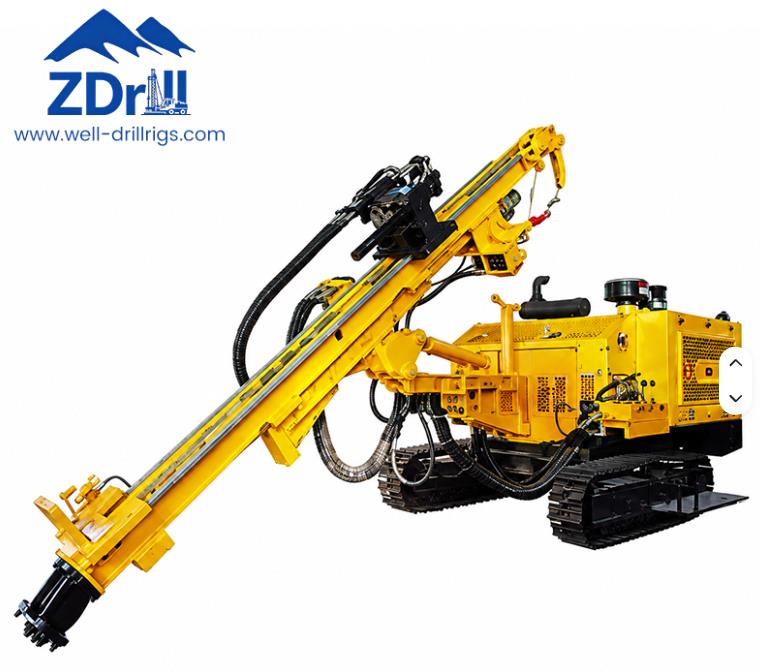
The company states a design and production plan for 300-1500 m reverse circulation rigs for mineral development. The published parameter table for the crawler RC machine lists a maximum drilling depth of 500 m, with a hole diameter of 130-250 mm and a maximum opening diameter of 105-400 mm.
Hydraulic control and a crawler-mounted structure are described as common on these rigs to improve mobility and operational safety. A 7 × 24 hour after-sales service is stated in the parameter table.
The parameter table gives a clear set of figures: maximum drilling depth 500 m, hole diameter 130-250 mm, maximum opening diameter 105-400 mm, diesel power, a Cummins engine, pneumatic DTH hammer drilling, air consumption 16-55 m³/min, rotary torque 5000-10000 N·m, weight 12,000 kg and dimensions of 7000 × 2100 × 2800 mm.
The table lists a minimum order quantity of one set, a one-year warranty, place of origin China, and a brand name that appears as ZDrill in the table. A later paragraph uses an older company name; we use ZDrill consistently. A machinery test report and video outgoing inspection are listed as available.
The page also states a 300-1500 m design and production plan for RC rigs. Treat this as a configuration range to discuss, not a guaranteed depth for the exact machine quoted.
Penetration rate, exact compressor model and fuel consumption are not stated in the table. Those figures should be marked to be confirmed in writing rather than estimated from general RC experience.
The published machine is a crawler-mounted RC rig with a Cummins engine and pneumatic DTH hammer method. It suits mineral exploration and geological survey work where mobility and sample quality both matter.
An air compressor matched to the 16-55 m³/min demand is central to the system. Confirm whether the compressor ships with the rig and what model is proposed.
Dual-wall rods, DTH hammers and bits complete the circulation path. Our drill tools can be specified with the rig so the hammer, rods and hole diameter work as a set.
RC is widely used where fast, representative samples drive exploration decisions. Reduced contamination and high recovery make it a standard choice in resource programs.
Survey holes in fractured or gravelly ground benefit from the sealed sample return. The rig is listed for geological exploration and investigation work.
The page lists water well drilling as an application. In hard rock and gravel, RC can reach the target zone faster than rotary mud methods that must stabilise a loose wall.
Foundation work in complex formations can use RC for fast boreholes and clean cuttings. Confirm the delivered diameter against the design before specifying the rig.
| RC System Component Checklist | ||
| Component | Purpose | What to Confirm |
|---|---|---|
| Air compressor | Supplies the DTH hammer and lifts cuttings | Model and delivery against 16-55 m3/min demand |
| DTH hammer | Breaks rock at the bit | Size matched to the 130-250 mm hole |
| Dual-wall drill rods | Carries cuttings inside the pipe | Length, connections and spares |
| Cyclone separator | Separates sample from the air stream | Flow capacity for the chosen compressor |
| Dust collection | Controls fine material at the surface | Configuration for site rules |
| RC rig | Crawler-mounted drilling platform | Delivered depth, torque and warranty in writing |
A missing component does not stop the truck, it stops the hole. Confirm the whole circulation path before the rig is dispatched.
Air consumption is listed at 16-55 m³/min. Match the compressor to your target depth and hole diameter, and ask what penalty a smaller unit would bring in penetration rate.
The table lists a 130-250 mm hole diameter and a 105-400 mm maximum opening diameter. Confirm which figure applies to your tooling and the formation you will drill.
The parameter table gives 500 m maximum depth, while the design plan mentions 300-1500 m. Ask which applies to the exact build and whether the figure is a rating or a design target.
Cyclone and dust collection are part of the system, not decoration. Specify them for the material you expect and the site rules you must meet.
Run the hammer, air system and rod handling under load. Our service and technical support covers delivery training and on-site service.
Set the crawler on firm, level ground with room for the compressor and sample handling area. The published dimensions are 7000 × 2100 × 2800 mm, so plan the pad accordingly.
Level the machine before raising the mast and check alignment after the first rod. Stable setup keeps the dual-wall string straight and the sample path clean.
Position the cyclone and dust collection downwind where possible, and plan a clear route for rods and sample bags. On remote sites, confirm fuel, spare rods and hammers before drilling begins.
We publish depth, hole diameter, opening diameter, air demand, torque, weight, dimensions, engine brand, warranty and MOQ for the RC machine. Demand the same level of detail from any supplier and mark the rest as to be confirmed.
Ask which components change for a deeper or larger-diameter build. A parts list can be audited; a changed number on a brochure cannot.
Ask for examples in similar hardness and fracture conditions. A rig rated for hard rock may be overbuilt for soft overburden and underpowered for deep, fractured zones.
Confirm spare-parts supply and fault response before you buy. The published table states 7 × 24 hour after-sales service; ask how that works in practice at your site.
We treat RC as a complete air-and-sample system, not a bare rig. The published crawler machine gives buyers real figures to work with: 500 m depth, 130-250 mm hole diameter, 16-55 m³/min air demand, 5000-10000 N·m torque and a Cummins engine. We pair it with the right compressor, rods and sample equipment and mark unstated figures for written confirmation. Shijiazhuang Zhengdrilling Machinery Equipment Co., Ltd. supports custom configurations about our company and capabilities for mineral and water projects.
The published parameter table lists a maximum depth of 500 m for the crawler RC machine. The page also mentions a 300-1500 m design and production plan. Confirm which figure applies to your build and whether it is a rating or a target.
The table lists air consumption of 16-55 m³/min. The right compressor depends on depth, hole diameter and hammer size. Confirm the proposed model and whether it is included in the quotation.
The parameter table gives a hole diameter of 130-250 mm and a maximum opening diameter of 105-400 mm. Ask which applies to your tooling and confirm the delivered diameter in writing.
Cuttings return through the inside of a dual-wall drill pipe, so they have less contact with the borehole wall. That reduces contamination and gives a more representative sample for logging or assay.
The table lists a one-year warranty, a minimum order of one set and 7 × 24 hour after-sales service. Request the written warranty terms and the spare-parts plan before purchase.
Processing Demand Survey
x


